The Great Human Shift
Contemporary digital technologies are best understood not as isolated tools but as components of a broader environmental transition: the emergence of adaptive digital environments that sense behaviour, personalise experience, and increasingly participate in cognition itself.
- Research
- AI
- Cognitive Science
Abstract
Recent advances in artificial intelligence, algorithmic systems and digital technologies have generated substantial scholarly interest across psychology, cognitive science, human-computer interaction and the social sciences. These developments, however, have largely been investigated as separate phenomena. This paper proposes that they are more accurately understood as interconnected manifestations of a broader environmental transition: the emergence of adaptive digital environments that observe behaviour, personalise experience at the level of the individual and increasingly participate in cognitive activities that were previously regarded as exclusively human. Drawing on Lewin's field theory, media ecology, distributed cognition, the extended mind thesis, ecological systems theory and niche construction theory, the paper develops an integrative conceptual framework and advances five falsifiable propositions concerning attention, cognitive downtime, cognitive offloading, human-AI collaboration and adaptive choice architecture. Evidence bearing on each proposition is reviewed, together with alternative interpretations, including the modest effect sizes reported in parts of the digital technology literature and the long history of unwarranted alarm surrounding new media. The contribution is conceptual rather than empirical. By shifting the unit of analysis from individual technologies to the environments those technologies collectively create, the paper seeks to provide a foundation for longitudinal, interdisciplinary research into how increasingly adaptive environments shape the development of human cognition.
Keywords: adaptive environments; attention economy; cognitive offloading; human-AI collaboration; choice architecture; distributed cognition
1. Introduction
Recent advances in artificial intelligence, algorithmic systems, and digital technologies have generated substantial scholarly interest across disciplines, including psychology, cognitive science, human-computer interaction, information systems, and the social sciences. Research has examined phenomena such as the attention economy, persuasive technologies, cognitive offloading, recommendation systems, human-AI collaboration and the societal implications of increasingly capable artificial intelligence. Collectively, this body of work has significantly improved understanding of how individual technologies influence human behaviour and decision-making.
Despite this growing literature, these developments have largely been investigated as separate phenomena. Research on digital attention rarely intersects with studies of cognitive offloading. Investigations of human-AI collaboration often remain distinct from work on persuasive technology, while studies of recommendation systems, adaptive interfaces and algorithmic personalisation frequently evolve within different disciplinary traditions. As a consequence, comparatively little attention has been devoted to a broader conceptual question: do these developments represent independent technological advances, or are they interconnected manifestations of a more fundamental transformation in the environments within which human cognition develops?
This paper argues for the latter interpretation. Rather than viewing contemporary digital technologies as isolated innovations, it proposes that they are more accurately understood as components of a broader environmental transition. The defining characteristic of the current technological era is not simply the emergence of increasingly capable computational systems, but the emergence of increasingly adaptive digital environments that participate in shaping attention, learning, reasoning, communication and decision-making. This proposition does not reject existing technological explanations. Instead, it seeks to integrate them within a common conceptual framework through which seemingly independent developments may be understood as expressions of the same underlying historical process.
Viewing technological change through the lens of environmental transformation is not without historical precedent. Human history has repeatedly been shaped by changes in the environments within which individuals and societies developed. The Agricultural Revolution transformed humanity's relationship with food production, settlement and community. The Industrial Revolution fundamentally altered patterns of production, labour and economic organisation. The Information Revolution reshaped the creation, storage and distribution of knowledge on an unprecedented scale. In each instance, the long-term consequences extended beyond the technologies themselves, as they altered the conditions under which human behaviour, institutions and cultures evolved.
The present technological transition may represent a continuation of this historical pattern, while also exhibiting characteristics that distinguish it from previous periods of change. Earlier technological revolutions primarily expanded human capability by increasing access to physical resources, mechanical power or information. Contemporary digital systems increasingly do something more. They observe behaviour, adapt to individual users, personalise information, optimise interactions and participate in cognitive activities that were previously regarded as exclusively human. Consequently, technology no longer functions solely as an external tool that extends capability; it increasingly contributes to the environments within which capability itself develops.
The significance of this distinction can be illustrated by considering three individuals born in different technological eras. A person born in 1970, another born in 2000 and a child born in 2025 are separated by relatively little biological change. They are, however, separated by profoundly different developmental environments. The first matured in an environment characterised by comparatively scarce information, extended periods of uninterrupted attention and limited technological mediation of everyday life. The second experienced the transition to pervasive internet connectivity, smartphones and social media. The third is likely to develop within environments characterised by continuous algorithmic adaptation, ubiquitous digital connectivity and increasingly capable artificial intelligence. The importance of this comparison lies not in generational differences themselves, but in recognising that the environments surrounding human cognition have changed more rapidly than human biology has.
This observation motivates the central research question addressed throughout this paper: if the environments within which cognition develops have fundamentally changed, what are the implications for individuals, societies and future generations? Addressing this question requires moving beyond evaluating individual technologies in isolation and instead examining the cumulative effects of adaptive digital environments on human cognitive development. The objective is not to determine whether technological progress is beneficial or harmful, but to investigate how increasingly adaptive technological environments may influence the conditions under which attention, knowledge, reasoning and decision-making emerge.
The contribution of this paper is therefore conceptual rather than empirical. It synthesises evidence from psychology, cognitive science, human-computer interaction, behavioural science and artificial intelligence research to propose an interdisciplinary framework for understanding contemporary technological change. Within this framework, developments commonly discussed as independent phenomena, including the attention economy, constant connectivity, recommendation systems, cognitive offloading, human-AI collaboration and adaptive artificial intelligence, are interpreted as interconnected evidence of a broader environmental transition. By bringing these bodies of literature into dialogue, the paper seeks to provide a perspective through which recent technological developments can be understood collectively rather than independently.
The sections that follow develop this argument progressively. Section 2 examines whether the current technological transition differs qualitatively from previous historical transformations and situates the argument within established theoretical traditions. Section 3 specifies the proposed conceptual framework, defines its central construct and states five propositions that future empirical research can test. Sections 4 to 8 synthesise evidence from multiple disciplines to explore how adaptive digital environments influence attention, cognitive downtime, knowledge acquisition, collaborative reasoning and human decision-making. Section 9 integrates these observations and considers alternative interpretations of the evidence, while Sections 10 and 11 discuss the broader implications, limitations and future directions for research. Rather than presenting definitive conclusions, the paper aims to establish a foundation for investigating what may become one of the defining scientific and engineering questions of the twenty-first century: how do increasingly adaptive environments shape the development of human cognition?
2. Is This Time Different?
The central proposition advanced in the Introduction is that contemporary digital technologies may be better understood as components of a broader environmental transition rather than as isolated technological innovations. If this proposition is accepted, an important question follows. Does the present technological era represent a continuation of previous historical patterns, or does it possess characteristics that distinguish it from earlier periods of technological change?
This question warrants careful consideration because history provides numerous examples of technologies that fundamentally altered human societies. The printing press transformed literacy and the dissemination of knowledge. The Industrial Revolution redefined production, labour and economic organisation. Electricity reshaped domestic life and industrial productivity, while radio, television and the internet successively transformed communication at national and global scales. Each of these innovations generated profound social, economic and cultural consequences, many of which became fully apparent only over extended periods of historical development.
For this reason, it would be intellectually unjustified to argue that the current technological transition is historically unique simply because it is contemporary. Rather, the argument advanced in this paper is more specific. The question is not whether modern technologies are more powerful than those that preceded them, but whether the relationship between humans and technology is itself undergoing a qualitative transformation.
Addressing this question requires moving beyond the technologies themselves and considering a principle that has shaped research across psychology, sociology, education and organisational science for almost a century: human behaviour cannot be understood independently of the environments within which it occurs. Among the earliest and most influential articulations of this principle was Lewin's Field Theory, which proposed that behaviour is a function of both the person and their environment, commonly expressed as (Lewin, 1936, 1951). Lewin's formulation represented a significant shift in behavioural science because it rejected explanations based solely on individual characteristics and instead emphasised the reciprocal relationship between individuals and the environments in which behaviour occurs.
The influence of this perspective extends well beyond psychology. Bronfenbrenner (1979) extended it developmentally, arguing that human development unfolds within nested ecological systems whose characteristics shape the capabilities that emerge within them. Within philosophy of mind and cognitive science, the extended mind thesis proposed that cognitive processes routinely extend beyond the individual into external artefacts, such that a notebook or a device may function as part of the cognitive system itself (Clark & Chalmers, 1998), while Hutchins' (1995) theory of distributed cognition demonstrated empirically that cognition frequently emerges through interactions among people, artefacts and their surrounding environments. Across these disciplines, environments are increasingly recognised not as passive settings within which behaviour unfolds, but as active components that shape learning, decision-making, social interaction and organisational behaviour. Although these traditions differ in their theoretical assumptions and empirical methods, they converge on a common principle: changes in environmental conditions frequently produce corresponding changes in human behaviour and cognition.
A further tradition deserves particular attention because it anticipates the reciprocal relationship at the centre of this paper. Niche construction theory describes how organisms systematically modify their environments and, in doing so, alter the conditions and selection pressures acting upon themselves and their descendants (Odling-Smee, Laland & Feldman, 2003). Research on culture and human evolution has similarly documented how culturally constructed environments, from cooking and writing to formal institutions, have shaped human cognitive capacities over historical and evolutionary time (Henrich, 2016). Human beings, in other words, have always constructed the environments that in turn construct them. The feedback relationship examined throughout this paper is therefore not new in kind. What may be new, as the following sections argue, is its speed, its granularity and its scale.
Viewed from this perspective, every major technological revolution can also be interpreted as an environmental transformation. The printing press altered the intellectual environment by dramatically expanding access to written knowledge. Industrialisation transformed the physical, economic and organisational environments within which societies functioned. The internet fundamentally reshaped the information environment by reducing the cost of creating, distributing and accessing knowledge on a global scale. Historians of technology have similarly argued that successive technological revolutions reshape not only productive capability but also the wider institutional, economic and social contexts within which human activity unfolds (Mumford, 1934; Perez, 2002; Hughes, 2004). In each case, technological innovation altered the conditions under which individuals learned, communicated and participated in society.
The present technological transition appears to extend this historical pattern while introducing an important distinction. Earlier technologies generally expanded human capability by providing access to new resources, faster communication or greater computational power. Once deployed, however, those technologies remained comparatively static. A printing press did not adapt to the individual reader. A textbook presented the same information regardless of who opened it. Early software systems similarly delivered largely identical experiences to every user.
Contemporary digital systems increasingly operate according to different principles. Search engines personalise information retrieval. Recommendation systems continuously reorganise content based on behavioural signals. Social media platforms optimise engagement through adaptive algorithms. Advertising systems learn from user interactions, while generative artificial intelligence increasingly adapts responses according to conversational context and previous exchanges. Consequently, two individuals using the same technological platform may experience substantially different digital environments because those environments evolve in response to their behaviour.
This observation should not be interpreted as criticism of technological progress. Personalisation has produced substantial societal benefits, including improved access to information, more effective educational technologies, enhanced accessibility, personalised healthcare and more efficient digital services. The contribution of adaptive technologies to human capability is both significant and well documented. The argument advanced here concerns a different question. If technologies increasingly participate in constructing the environments within which cognition occurs, then the scientific object of inquiry extends beyond technology itself. The focus shifts towards understanding how adaptive environments influence attention, learning, reasoning, decision-making and the development of expertise over time.
This perspective resonates with McLuhan's (1964) argument that the long-term influence of technology cannot be understood solely through the content it conveys, but also through the environments it creates for perception, communication and social organisation. Later developments within media ecology similarly emphasised that technologies should be understood not merely as tools but as an environment that shapes patterns of human interaction and cultural development (Postman & Weingartner, 1969). More recently, Floridi (2014) has characterised contemporary life as unfolding within an infosphere in which the boundary between online and offline experience is progressively dissolving. The present paper extends these perspectives by arguing that contemporary adaptive digital systems differ from earlier media environments in one important respect: they increasingly respond to the behaviour of those who inhabit them. Rather than remaining comparatively static, these environments learn from interaction, personalise future experiences and continuously adapt over time. In this sense, the framework proposed here builds upon, rather than replaces, the media-as-environment perspective developed by McLuhan and subsequent media ecologists.
Whether this distinction ultimately represents a historical turning point remains an open empirical question. The purpose of this paper is not to claim that such a conclusion has already been established, but to argue that the possibility warrants systematic investigation. If nearly a century of research suggests that environments play a fundamental role in shaping human behaviour, then understanding the emergence of increasingly adaptive digital environments becomes not simply a question of technological innovation, but a question concerning the future development of human cognition itself. The next section gives that argument a more precise form.
3. The Adaptive Environments Framework
The argument so far has been stated informally. To be scientifically useful, however, a conceptual framework must specify its central construct and state what should be observed if its claims are correct. This section does both.
The central construct of the framework is the adaptive environment. An adaptive environment is defined here as a technologically mediated environment exhibiting four properties. The first is continuous behavioural sensing. The environment observes and records the behaviour of its inhabitants at high temporal resolution, including what is viewed, for how long, what is selected, what is ignored and what prompts return. The second is individual-level personalisation. The environment differentiates itself for each inhabitant, such that two individuals engaging with the same system encounter systematically different content, structure or interaction. The third is closed-loop optimisation. The environment modifies itself algorithmically in response to sensed behaviour, typically in the service of an explicit objective such as engagement, retention or relevance, producing a continuous cycle in which behaviour generates data, data reshapes the environment, and the modified environment influences subsequent behaviour. The fourth is cognitive participation. In its most recent form, the environment does not merely present information but contributes to cognitive activity itself, generating text, proposing alternatives, explaining, summarising and revising outputs through dialogue.
Where an environment of this kind materially influences how capability develops over time, this paper refers to it as a capability environment: the collection of technological, social, educational, organisational and cognitive conditions that shape the development of human capability. The process through which repeated interaction with such an environment influences the direction of that development may be termed capability shaping, and shaping may be intentional or unintentional. The framework's central concern is that contemporary adaptive environments shape capability continuously while being optimised for objectives in which capability plays no part.
These properties distinguish adaptive environments from environments that are designed but static. A classroom, a library, a supermarket or a printed textbook may be carefully engineered to influence behaviour, but once constructed each remains largely identical for everyone who enters it. Choice architecture in the classical sense (Thaler & Sunstein, 2008) is designed once and encountered by many; an adaptive choice architecture is redesigned continuously and encountered by one. The first three properties characterise most contemporary digital platforms. The fourth is, at present, principally a property of generative artificial intelligence systems. Adaptivity should therefore be understood as a continuum rather than a binary category, and environments may be more or less adaptive along each of the four dimensions.
The boundaries of the construct deserve equal precision. Not every digital technology constitutes an adaptive environment. A calculator, a spellchecker, a static website or an electronic book may be sophisticated, but none satisfies the four properties: they do not continuously sense behaviour, differentiate themselves for each user, or modify themselves through closed-loop optimisation. Nor does the framework predict effects wherever adaptivity exists. Its propositions concern environments with which individuals interact frequently and over sustained periods, such that the feedback loop between behaviour and environment has the opportunity to operate. Occasional or incidental contact with adaptive systems falls outside the scope of the predictions, and effects are expected to scale with the frequency, duration and developmental timing of exposure. An environment that is adaptive but rarely inhabited is, for the purposes of this framework, of little consequence.
The distinction between static and adaptive environments can be stated compactly. Lewin's formulation, , treats the environment as a given within which behaviour unfolds. Adaptive environments introduce a second function. Behaviour at a given moment depends on the person and the environment as before,
but the environment encountered at the next moment is itself a function of the behaviour just observed,
The second expression is the formal core of the framework, because it closes the loop between behaviour and environment. Nothing quantitative is claimed by this notation. Its purpose is to make the structural difference explicit, since the classical formulation contains no term through which behaviour reshapes the environment, and to indicate where empirical work can attach itself. Characterising the update function for a given platform, including what it senses, what it optimises and how quickly it responds, is precisely the kind of task that the propositions below are intended to motivate.
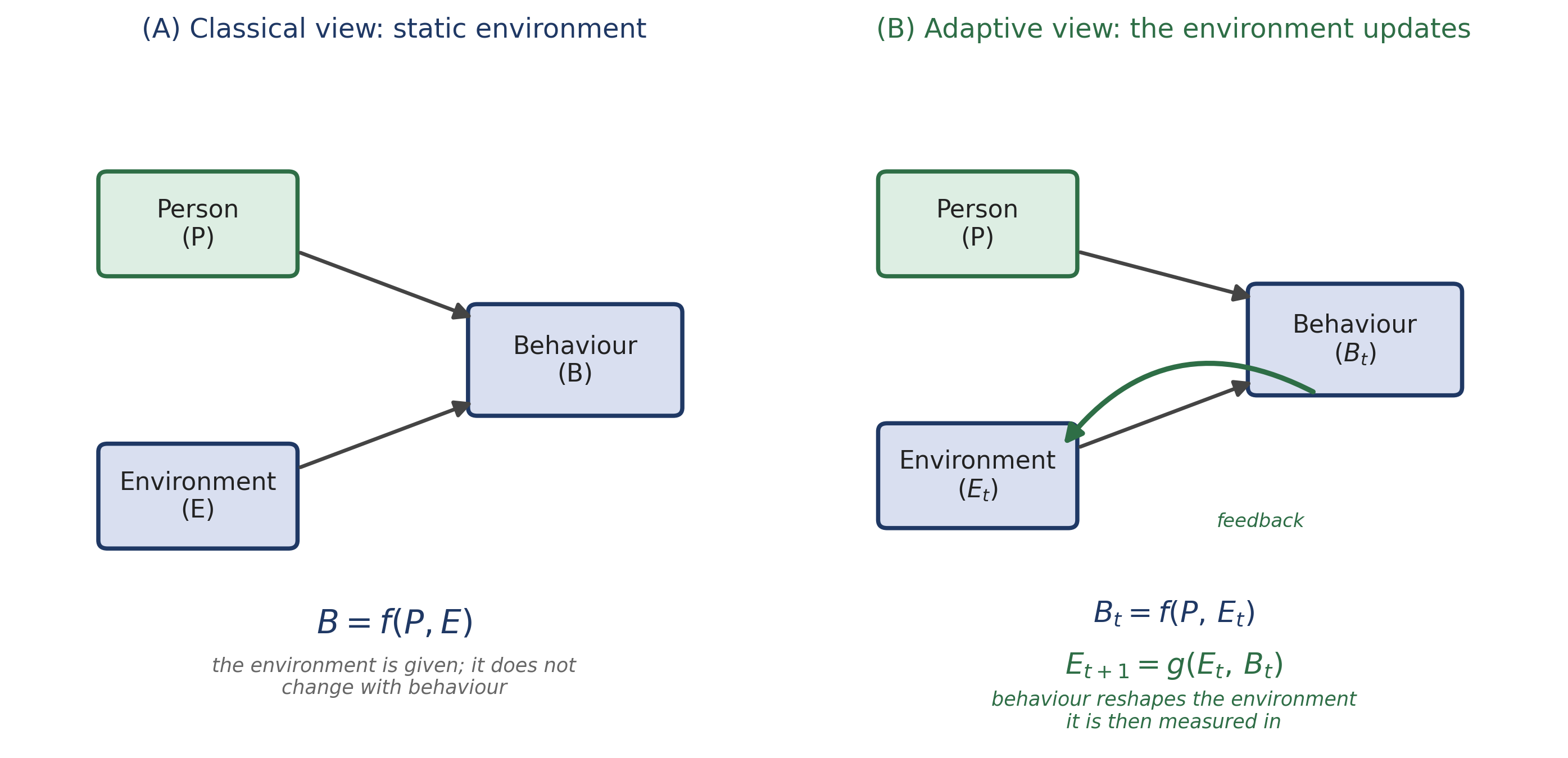
Figure 1. The classical and adaptive views of the person-environment relationship. In the classical view (A), behaviour is a function of the person and the environment, , and the environment is treated as given. In the adaptive view (B), behaviour still depends on the person and the current environment, but the environment itself updates in response to the behaviour it has just observed, , closing a feedback loop that the classical formulation lacks. The second function is the structural core of the framework: it is the term through which contemporary adaptive systems reshape the environments in which cognition subsequently develops.
If environments of this kind increasingly host human attention, learning, reasoning and decision-making, the framework predicts observable consequences. These are stated below as five propositions. Each is intended to be falsifiable, and each corresponds to a body of evidence reviewed in Sections 4 to 8.
Proposition P1.1 (Attention). Where digital environments are optimised for engagement, the allocation of user attention will shift measurably towards content selected by the environment and away from goals initiated by the user, relative to functionally equivalent environments that do not adapt.
Proposition P1.2 (Cognitive downtime). The adoption of continuously available adaptive media reduces the frequency and duration of externally undemanding intervals, with corresponding reductions in the internally directed cognition, such as mind-wandering, reflection and memory consolidation, that those intervals support.
Proposition P1.3 (Cognitive offloading). As the cost of external retrieval approaches zero, individuals increasingly encode routes to information rather than the information itself, and the comparative cognitive demand placed on human users shifts from acquisition and retention towards evaluation and verification.
Proposition P1.4 (Collaborative cognition). The cognitive consequences of human-AI collaboration depend on how cognitive responsibility is distributed rather than on the presence of AI as such. Delegating the evaluative components of a task predicts reduced critical engagement, whereas delegating executive components does not.
Proposition P1.5 (Adaptive choice architecture). The influence of personalised choice architectures on decision-making increases with accumulated interaction history, producing individually divergent decision environments whose effects are distinguishable from those of static, population-level choice architectures.
The propositions are not of equal standing. Proposition P1.1 is the most immediately tractable, since attention allocation can be compared between adaptive and matched non-adaptive environments over comparatively short timescales. Proposition P1.2 carries the greatest theoretical weight for the framework as a whole, because it concerns the developmental consequences that motivate the environmental perspective in the first place, and it is correspondingly the most demanding to test. Propositions P1.3 to P1.5 extend the framework into specific domains of cognition and choice. One further commitment follows from the logic of the framework itself. Because the five phenomena are claimed to share a common driver, they should covary; if they prove empirically independent of one another, the aggregation proposed here would be disconfirmed rather than merely refined, a point developed further in Section 9.
Two clarifications constrain of the framework. It is not a deterministic claim. None of the propositions asserts that adaptive environments abolish agency or fix outcomes; they assert only that such environments alter the distributions of attention, effort and choice in measurable ways. Nor is it an evaluative claim. Adaptivity has produced substantial and well-documented benefits, and nothing in the framework implies that those benefits are illusory. The framework earns its place only if it pays its way twice over: by explaining the scattered findings on attention, offloading, and collaboration more coherently than studying each technology alone, and by prompting experiments that the technology-by-technology view never thought to run. The sections that follow test the first of these against the existing evidence, proposition by proposition..
4. The First Evidence: When Attention Became an Economic Resource
If the previous sections argued that the present technological transition differs because digital systems increasingly shape the environments in which people think, learn and behave, the next question follows naturally: where can this transformation first be observed? One of the clearest answers is human attention.
Attention has long occupied a central position within psychology and cognitive science because it underpins almost every higher-order cognitive process. Learning, memory, reasoning, decision-making and problem solving all depend, to varying degrees, on where attention is directed and how long it can be sustained. Consequently, changes in the way attention is allocated have implications that extend far beyond individual moments of distraction. They influence the conditions under which people acquire knowledge, develop expertise and exercise judgement.
Long before smartphones, social media platforms or generative artificial intelligence became part of everyday life, Herbert Simon recognised a challenge that would become increasingly significant in the digital age. Writing in 1971, Simon argued that an abundance of information inevitably creates a scarcity of attention (Simon, 1971). His observation was deceptively simple. As societies become more effective at producing information, human attention becomes the limiting resource.
More than five decades later, Simon's insight appears increasingly relevant. According to the Digital 2025 Global Overview Report, more than five billion people now use social media worldwide, while the average internet user spends several hours online each day (We Are Social & Meltwater, 2025). Collectively, these figures represent one of the largest continuously connected populations in human history. The scale alone suggests that attention is no longer simply a psychological construct. It has become an economic resource that influences advertising, commerce, education, entertainment, media and increasingly the design of digital technologies themselves.
This transformation did not occur because organisations suddenly decided to compete for attention. Rather, it emerged because digital environments created conditions in which attention became observable and measurable. For the first time, organisations could examine, at unprecedented scale, how long individuals viewed a piece of content, what attracted their interest, when they disengaged, what they ignored, what they selected and what persuaded them to return. Measurement fundamentally altered the relationship between technology and human behaviour. Once attention could be measured, it could be analysed. Once it could be analysed, it could be modelled. Once it could be modelled, it could be optimised. This progression is neither unusual nor inherently problematic. Engineering has always sought to improve what can be measured. The same principle underpins advances in manufacturing, healthcare, transportation and software engineering. Digital platforms simply applied that principle to one of humanity's most limited cognitive resources.
The result is what Davenport and Beck (2001) described as the attention economy, a concept later expanded by Wu (2016), who traced how competition for human attention evolved into one of the defining commercial forces of the digital era. Within this environment, attention functions not merely as something individuals possess, but as a resource that can be measured, predicted and increasingly optimised.
Importantly, describing attention as an economic resource should not be interpreted as a moral judgement. Markets naturally emerge around scarce and valuable resources. In the digital economy, attention became one such resource because it enables advertising, supports subscription models, improves recommendation systems and allows digital services to personalise user experiences more effectively. Many of these developments have generated substantial public benefit. Recommendation systems help users discover educational resources, scientific literature, music, communities and professional opportunities that might otherwise remain inaccessible. Personalisation reduces the effort required to locate relevant information. Adaptive interfaces improve accessibility, while intelligent systems increasingly tailor experiences to individual needs across education, healthcare and everyday life.
The question advanced by this paper, and formalised in Proposition P1.1, is therefore not whether these developments have produced benefits. The literature already demonstrates that they have. Rather, the question is whether continuously optimising for attention also changes the environments within which people think, learn and make decisions. Research across human-computer interaction, persuasive technology and behavioural science has consistently demonstrated that interface design, notification systems, social feedback mechanisms and recommendation algorithms influence patterns of user engagement and behaviour (Fogg, 2003; Amershi et al., 2019). Individually, these studies examine specific technologies, interfaces or behavioural outcomes. Collectively, however, they point towards a broader pattern. Modern digital environments are increasingly designed not only to deliver information, but also to shape how attention is directed, sustained and redistributed over time.
The concern is not that attention has become valuable. Attention has always been valuable. The change is that, for the first time in history, billions of people participate every day in adaptive digital environments that continuously observe, learn from and respond to patterns of human attention. The environment itself has become increasingly dynamic, adjusting to behaviour as behaviour simultaneously adjusts to it. Whether this reciprocal relationship ultimately influences long-term human development remains an open scientific question, and current evidence does not justify deterministic conclusions. It does, however, justify recognising that the conditions surrounding human attention have changed in ways without clear historical precedent.
Attention therefore provides the first substantive piece of evidence supporting the broader proposition advanced throughout this paper. The next section examines a closely related consequence of this transformation. If attention has become a continuously contested resource, what happens when opportunities for uninterrupted thought become increasingly rare?
5. The Disappearing Space for Thought
The preceding section argued that contemporary digital environments increasingly compete for human attention and that attention itself has become an important economic resource. If this interpretation is accepted, an important consequence follows. As digital systems become progressively more successful at attracting and retaining attention, opportunities for uninterrupted cognition may become correspondingly less frequent. This possibility raises a broader question concerning the environments within which higher-order cognitive processes develop. Rather than asking whether digital technologies interrupt attention, the more significant question, stated in Proposition P1.2, is whether persistent reductions in cognitive downtime alter the conditions under which reflection, memory consolidation, creative thought and self-directed reasoning occur.
Within psychology and cognitive neuroscience, periods of externally undemanding activity have long been recognised as serving functions beyond simple inactivity. Research on mind-wandering suggests that when immediate environmental demands are reduced, attention frequently shifts towards internally directed cognitive processes associated with autobiographical memory, prospective thinking, creative problem solving and self-reflection (Smallwood & Schooler, 2015). Similarly, research on the brain's default mode network has demonstrated that periods of quiet wakefulness are characterised by patterns of neural activity associated with internally generated cognition, memory consolidation and the integration of prior experience (Raichle et al., 2001; Buckner, Andrews-Hanna & Schacter, 2008). Collectively, these findings suggest that periods of apparent inactivity may contribute to cognitive processes that are difficult to sustain under conditions of continuous external engagement.
The relevance of this literature extends beyond questions of individual attention. Throughout much of human history, everyday life naturally contained intervals during which external cognitive demands were comparatively limited. Waiting for transport, travelling, standing in queues or completing routine activities often created opportunities for internally directed thought without deliberate effort. These periods were not intentionally designed for reflection, yet they provided environments in which spontaneous cognitive processes could occur with relatively few competing demands.
Contemporary digital environments increasingly alter these conditions. Mobile devices, persistent connectivity and algorithmically curated content have substantially reduced the duration between moments of inactivity and renewed external engagement. Information, communication and entertainment are now available with minimal delay, allowing previously unoccupied moments to become opportunities for interaction. This transformation has generated significant societal benefits by improving communication, expanding access to knowledge and reducing barriers to information. At the same time, it has altered the temporal structure of everyday cognition in ways that remain insufficiently understood.
Importantly, the argument advanced here is not that digital engagement is inherently detrimental, nor that uninterrupted reflection is invariably beneficial. Existing empirical evidence does not support such deterministic conclusions. Rather, the available literature suggests that human cognition operates across multiple complementary modes, each contributing differently to learning, reasoning and decision-making. If digital environments systematically influence the frequency with which these modes occur, then understanding those environmental changes becomes an important scientific question rather than simply a matter of technology use.
Empirical research examining digital media use provides preliminary support for this perspective. Studies have associated frequent media multitasking and repeated digital interruptions with differences in sustained attention and cognitive control (Ophir, Nass & Wagner, 2009), and experimental work has shown that the mere presence of one's own smartphone can reduce available cognitive capacity even when the device is not in use (Ward, Duke, Gneezy & Bos, 2017). At the same time, reviews of this literature emphasise that these relationships remain highly dependent on individual characteristics, task demands and patterns of technology use (Wilmer, Sherman & Chein, 2017; Firth et al., 2019). These findings should therefore be interpreted cautiously. They do not demonstrate that digital technologies diminish cognition. Instead, they suggest that changes in the environments surrounding cognition warrant continued longitudinal investigation.
Viewed within the broader framework proposed throughout this paper, the significance of these findings lies less in the individual technologies involved than in the cumulative transformation of the environments within which cognition occurs. Attention increasingly competes with adaptive digital systems, while periods that once supported internally directed thought are progressively integrated into continuously connected information environments. This provides a second line of evidence supporting the central proposition of the paper, and it leads naturally to the next stage of the argument. If digital environments increasingly influence not only how attention is allocated but also the conditions under which reflection occurs, it becomes necessary to examine how those same environments are reshaping humanity's relationship with knowledge itself.
6. When Knowing Changed
Few technological developments have transformed modern society as profoundly as the democratisation of access to information. Over the past three decades, advances in digital infrastructure have fundamentally reduced the time required to acquire knowledge. Information that previously required consultation of libraries, printed texts or domain experts can now be retrieved within seconds through search engines, digital repositories and, increasingly, generative artificial intelligence. Universities distribute lectures globally through online platforms, scientific publications are accessible across national boundaries, real-time translation reduces linguistic barriers, and digital archives provide unprecedented access to historical and contemporary knowledge. Collectively, these developments represent one of the most significant expansions of human access to information in recorded history.
The significance of this transformation extends beyond technological convenience. Throughout history, access to knowledge has often been constrained by geography, economic resources and institutional structures. Digital technologies have substantially reduced many of these barriers, enabling broader participation in education, scientific communication and professional development. From this perspective, the contemporary information environment should be regarded as a major achievement rather than a problem requiring correction.
The argument advanced in this paper does not question these benefits. Instead, it considers whether a profound transformation in access to knowledge may also influence the cognitive environments within which knowledge is acquired, retained and applied. Environmental change has consistently been accompanied by behavioural adaptation throughout human history. It is therefore reasonable to ask, as Proposition P1.3 does, whether unprecedented access to external knowledge resources is accompanied by corresponding changes in the ways individuals engage with knowledge itself.
Research within cognitive psychology provides a useful framework for examining this question. Risko and Gilbert (2016) describe the phenomenon of cognitive offloading as the use of external resources to reduce demands on memory and other cognitive processes. Importantly, cognitive offloading is neither novel nor inherently problematic. Written language, maps, calendars, libraries, mathematical notation and calculators all represent historical examples of technologies that extend cognitive capability beyond the biological limitations of individual memory. Rather than replacing human cognition, these tools have consistently expanded the range of problems that individuals and societies are capable of solving.
There is, moreover, direct experimental evidence that offloading changes what individuals encode. Sparrow, Liu and Wegner (2011) demonstrated that when people expect information to remain externally available, they preferentially remember where to find that information rather than the information itself. This finding provides early empirical support for the first part of Proposition P1.3: as retrieval becomes effortless, individuals increasingly store routes to knowledge rather than knowledge.
The transfer of cognitive processes from the individual to external technological systems may be termed capability externalisation. Externalisation is neither inherently beneficial nor harmful: whether it produces capability growth, preservation or decay depends on what the individual does with the capacity it releases. The relevant design distinction is between technologies that achieve capability amplification, extending human capacities while leaving them central to task completion, and technologies that substitute for those capacities entirely. Amplification and substitution may produce identical immediate output while diverging in their long-term effects on the person, which is precisely why output alone cannot distinguish them.
Contemporary digital technologies represent a continuation of this historical trajectory while extending it into domains that increasingly involve higher-order cognition. Engelbart's (1962) influential conception of computers as technologies for augmenting human intellect anticipated many aspects of this transition, arguing that computational systems should enhance rather than replace human cognitive capability. Search engines increasingly function as external repositories of factual knowledge. Cloud-based systems preserve information that would previously have depended upon personal recall. Navigation technologies reduce the need for spatial memorisation, while machine translation systems diminish linguistic barriers to communication. More recently, generative artificial intelligence has extended this progression by supporting drafting, summarisation, software development, explanation and analytical reasoning.
This distinction is particularly relevant in the context of generative artificial intelligence. Public discussion frequently frames AI as a technology that may eventually replace human thinking. The emerging empirical literature suggests that this framing is overly simplistic. Instead, intelligent systems appear to redistribute cognitive effort by assuming responsibility for some components of complex tasks while leaving others under human control. In a large-scale study of knowledge workers, Lee et al. (2025) found that greater reliance on generative AI was associated with reduced self-reported cognitive effort for certain activities while simultaneously altering the ways participants evaluated, verified and applied information. Similarly, Gerlich (2025) reported associations between frequent AI use, cognitive offloading and reduced performance on measures of critical thinking. Both studies are cross-sectional and rely substantially on self-report, and neither establishes causal relationships; their findings should be read as preliminary and hypothesis-generating rather than conclusive. Together, however, they suggest that generative AI is not simply accelerating access to knowledge but may also be reshaping patterns of cognitive engagement during knowledge work.
The implications of this transition extend beyond information retrieval. Throughout much of human history, acquiring knowledge represented the primary challenge. Increasingly, however, access to information is no longer the principal constraint. Instead, greater value may lie in evaluating the credibility of information, integrating knowledge across domains, exercising sound judgement and determining when technological outputs require critical scrutiny. In this context, the comparative advantage of human cognition may shift away from information storage towards interpretation, evaluation and responsible decision-making.
This paper therefore does not argue that external cognitive technologies diminish human capability. Historical evidence suggests the opposite. Writing transformed civilization by preserving knowledge across generations. Printing accelerated the dissemination of ideas. Digital computing expanded scientific discovery and global communication. Artificial intelligence may ultimately represent another significant extension of human capability within this historical continuum. The question advanced here is more specific. As intelligent systems increasingly retrieve, organise and generate knowledge, how might they alter the environments within which human understanding develops? If the competition for attention represented the first observable shift, and the transformation of cognitive downtime the second, then the changing relationship between humans and knowledge constitutes a third line of evidence supporting the broader conceptual framework proposed throughout this paper.
The following section extends this argument by considering a related question. If intelligent systems increasingly assume responsibility for accessing and organising knowledge, which forms of human capability become most valuable in environments characterised by abundant information and increasingly capable artificial intelligence?
7. When Thinking Became Collaborative
The preceding section argued that digital technologies have fundamentally transformed humanity's relationship with knowledge by reducing the barriers to acquiring, retrieving and generating information. If intelligent systems increasingly influence how knowledge is accessed, a further question emerges. What are the implications when these systems begin to participate not only in information retrieval but also in the processes through which reasoning, problem solving and decision-making occur?
This question represents an important conceptual shift. Earlier generations of digital technologies primarily functioned as repositories, calculators or retrieval systems that extended human memory and computational capability. Contemporary generative artificial intelligence differs in a significant respect. Rather than merely providing access to information, these systems increasingly participate in iterative cognitive processes by generating explanations, proposing alternatives, responding to feedback and refining outputs through dialogue. Consequently, the interaction between human and machine becomes part of the reasoning process itself. The relevant question therefore becomes not whether artificial intelligence thinks in the human sense, but how the presence of increasingly capable cognitive technologies alters the environments within which human thinking occurs.
Theoretical foundations for this perspective predate contemporary artificial intelligence. Hutchins' (1995) theory of distributed cognition challenged the assumption that cognition is located exclusively within the individual mind, arguing instead that cognitive processes frequently emerge through interactions among people, artefacts and their surrounding environments. Navigation teams, written records, maps, instruments and organisational procedures were all presented as components of broader cognitive systems rather than merely external aids to individual reasoning. The extended mind thesis makes the complementary philosophical claim that external resources can constitute, and not merely support, cognitive processes (Clark & Chalmers, 1998). From this perspective, cognition has long been understood as an activity distributed across both social and material environments.
Generative artificial intelligence may represent the latest and most sophisticated extension of this principle. Unlike earlier cognitive technologies, however, contemporary AI systems engage users through interactive dialogue rather than passive information storage. They generate hypotheses, explain concepts, produce alternative interpretations, identify potential errors and revise outputs in response to human feedback. The resulting interaction is neither wholly human nor wholly machine-generated. Instead, reasoning increasingly emerges through an iterative process in which human judgement and computational capability complement one another.
Across professional domains, evidence of this transition is becoming increasingly apparent. Software developers collaborate with AI systems to explore alternative implementations and identify programming errors. Researchers employ generative AI to organise literature, refine research questions and evaluate competing explanations. Educators develop teaching materials through iterative interaction with AI-assisted systems, while clinicians and legal professionals increasingly use intelligent tools to organise information before applying domain expertise and professional judgement. Although the specific tasks differ, each illustrates a broader pattern in which intelligent systems contribute to aspects of reasoning while responsibility for interpretation, evaluation and final decision-making remains with the human user.
Emerging empirical research has begun examining the implications of collaborative intelligence across a variety of professional settings. Human-computer interaction research suggests that well-designed collaboration between humans and intelligent systems can improve productivity, creativity and problem-solving performance when AI complements rather than replaces human judgement (Amershi et al., 2019). In a large field experiment with management consultants, Dell'Acqua et al. (2023) found that generative AI substantially improved performance on tasks within the technology's frontier of competence, while performance degraded when participants deferred to the system on tasks beyond that frontier. More recent investigations indicate that AI assistance may reduce cognitive effort for certain knowledge-intensive tasks while simultaneously altering how individuals evaluate information, monitor outputs and engage in critical reasoning (Lee et al., 2025; Gerlich, 2025). Collectively, and consistent with Proposition P1.4, these findings suggest that the consequences of collaborative intelligence depend less on the presence of AI itself than on how cognitive responsibility is distributed between people and increasingly adaptive computational systems.
This distinction has important implications for understanding expertise. Throughout much of history, expertise was frequently associated with acquiring and retaining specialised knowledge. As intelligent systems assume increasing responsibility for retrieving, organising and generating information, expertise may become progressively characterised by different capabilities. Critical evaluation, contextual understanding, ethical reasoning, interdisciplinary synthesis and the ability to formulate meaningful questions may become increasingly important precisely because intelligent systems can perform many routine knowledge tasks with growing efficiency. Human value therefore shifts away from the possession of information alone towards the capacity to interpret, challenge and responsibly apply information generated within collaborative cognitive environments.
The argument advanced here should not be interpreted as suggesting that artificial intelligence replaces human thinking. Rather, it proposes that the environments within which thinking occurs are undergoing structural change. Cognitive activity is becoming progressively collaborative, not because machines have assumed responsibility for reasoning in its entirety, but because human reasoning increasingly unfolds through continuous interaction with adaptive computational systems. Whether this transformation ultimately enhances or constrains long-term human capability remains an open empirical question requiring sustained longitudinal investigation. Nevertheless, the available literature consistently indicates that intelligent systems are becoming integrated into the processes through which individuals analyse problems, generate ideas and evaluate possible solutions. The environment surrounding human cognition has therefore changed once again.
If attention represents the first observable transformation, cognitive downtime the second, and humanity's relationship with knowledge the third, then the emergence of collaborative cognition constitutes a fourth line of evidence supporting the central proposition of this paper. The next section considers a further implication of this transition. If intelligent environments increasingly shape attention, knowledge and collaborative reasoning, how might they also influence the decisions individuals make, often without those influences being consciously recognised?
8. The Invisible Architecture of Choice
Consider a familiar experience. A person unlocks their phone intending to reply to a message, only to have their attention redirected by a notification, a news headline, a recommended video and, perhaps, an advertisement related to a recent online search. Several minutes later, they remember the original purpose for picking up the device. For most people, this sequence is neither surprising nor unusual. It represents an ordinary interaction with modern technology. Yet, from a behavioural perspective, it illustrates something that is easy to overlook. Throughout those few minutes, numerous decisions were made, but the environment within which those decisions occurred had already been organised, prioritised and personalised before the individual engaged with it. The person remained free to ignore every recommendation and return immediately to the original task, but the conditions surrounding those decisions were not neutral. They had been deliberately designed and continuously adapted through previous interactions.
The proposition that environments influence behaviour is well established across psychology and behavioural science. Earlier in this paper, Lewin's formulation of behaviour as a function of both the person and the environment provided the theoretical foundation for understanding why changes in human environments deserve careful attention (Lewin, 1936, 1951). Behavioural economics later extended this perspective by demonstrating that relatively small changes in the way choices are presented can significantly influence decision-making without removing individual agency. Kahneman and Tversky's work on judgement under uncertainty challenged assumptions of perfectly rational decision-making (Kahneman & Tversky, 1979), while Thaler and Sunstein introduced the concept of choice architecture to describe how the organisation of environments can systematically influence behaviour while preserving freedom of choice (Thaler & Sunstein, 2008). Research within human-computer interaction reached similar conclusions from a technological perspective. Fogg's work on persuasive technology demonstrated that digital systems could encourage particular behaviours by carefully combining motivation, ability and contextual prompts (Fogg, 2003). Although these traditions developed independently, they converge on a common observation: behaviour is influenced not only by individual intention but also by the environments within which choices are encountered.
What distinguishes the current technological transition, and what Proposition P1.5 formalises, is not simply that environments influence behaviour. They always have. The distinguishing characteristic is that digital environments are increasingly adaptive. A classroom, library or supermarket may be carefully designed, but once constructed it remains largely unchanged for everyone who enters it. Digital environments operate differently. Recommendation systems reorganise information according to previous behaviour. Search engines personalise results. News feeds prioritise different stories for different individuals. Online retailers present different products to different customers, and intelligent systems increasingly tailor interactions according to accumulated patterns of behaviour. The economics of machine prediction make such personalisation progressively cheaper and more accurate over time (Agrawal, Gans & Goldfarb, 2022), while Zuboff (2019) has documented the commercial logic through which behavioural data is collected and used to fuel it. Consequently, two individuals accessing the same digital platform at the same moment may experience environments that differ substantially despite occupying the same physical space.
From an engineering perspective, this adaptability represents a remarkable achievement. Personalisation reduces information overload, improves accessibility, enables more relevant recommendations and allows digital systems to respond to the differing needs of millions of users simultaneously. These developments have created measurable benefits across education, healthcare, commerce and communication. The argument developed in this paper is therefore not that adaptive environments are inherently harmful. Rather, it is that their emergence introduces a new class of questions concerning human development. If environments influence behaviour, and if those environments increasingly adapt in response to the very behaviour they help to shape, then the relationship between people and their environments becomes dynamic rather than static.
This reciprocal relationship may represent one of the defining characteristics of the present technological era. Human behaviour generates data through everyday interaction. That data is used to refine the environment through recommendation systems, interface adjustments, predictive models and personalised experiences. The modified environment subsequently influences future behaviour, generating new data that further reshapes the environment. Rather than representing a one-directional process of technological influence, this relationship is characterised by continuous reciprocal adaptation between individuals and increasingly intelligent environments. This interpretation aligns with ecological perspectives that emphasise the reciprocal relationship between organisms and their environments (Gibson, 1979), while extending those ideas to digital environments capable of learning from and responding to human behaviour.
Taken in isolation, recommendation systems, algorithmic curation, online experimentation and personalised interfaces appear to represent independent technological developments. Viewed collectively, however, they reveal a broader transition that aligns with the central argument advanced throughout this paper. Human beings have always adapted to their environments. Increasingly, they are interacting with environments that simultaneously adapt to them. This does not diminish human agency, nor does it imply that technology determines behaviour. It suggests something both narrower and potentially more significant: the environments within which human choices emerge have become active participants in an ongoing process of mutual adaptation. Understanding that transition provides the final line of evidence before turning to the broader question that motivates this paper. Do these changes represent isolated advances in technology, or do they collectively signal the emergence of a new stage in the evolution of the human experience?
9. Seeing the Pattern
The preceding sections have examined several developments that are typically investigated within separate academic disciplines. Psychology has explored attention, cognitive downtime and memory (Simon, 1971; Smallwood & Schooler, 2015). Behavioural economics has examined judgement, decision-making and the influence of choice architecture (Kahneman & Tversky, 1979; Thaler & Sunstein, 2008). Human-computer interaction has investigated persuasive technology, adaptive interfaces and human-centred design (Fogg, 2003; Amershi et al., 2019). More recently, artificial intelligence research has begun examining human-AI collaboration, cognitive offloading and the redistribution of cognitive effort (Risko & Gilbert, 2016; Dell'Acqua et al., 2023; Gerlich, 2025). Considered independently, each of these fields addresses a different aspect of the relationship between humans and technology. This paper has asked whether they may also be describing different manifestations of the same underlying transition.
The argument developed throughout the preceding sections does not rest upon any single technology or empirical finding. Rather, it emerges from the convergence of multiple observations that have been independently documented across different disciplines. Human attention has become an increasingly valuable economic resource. Opportunities for cognitive downtime have become progressively occupied by continuously connected digital environments. Humanity's relationship with knowledge has changed as retrieval has become almost instantaneous and increasingly supported by intelligent systems. Thinking itself is becoming more collaborative as humans work alongside increasingly capable AI systems, while the environments surrounding everyday decisions are becoming adaptive, personalised and responsive to individual behaviour. Each observation is supported by its own body of evidence. Taken together, they appear to describe something larger than the sum of their individual parts, and each corresponds to one of the five propositions stated in Section 3.
At the beginning of this paper, Lewin's formulation that behaviour emerges through the interaction between individuals and their environments provided the theoretical foundation for the discussion (Lewin, 1936, 1951). The purpose of revisiting that principle here is not to reinterpret Lewin's work but to extend the conversation it began. If behaviour continues to emerge through interactions between people and their environments, then understanding how those environments have changed becomes an equally important scientific question. The evidence reviewed throughout this paper suggests that digital technologies are no longer functioning solely as external tools. Increasingly, they form part of the environments within which attention is allocated, knowledge is acquired, reasoning is performed, and decisions are made.
This observation also provides a different perspective on the history of technological progress. The printing press transformed access to knowledge. Electricity transformed production. Computing transformed information processing. The internet transformed communication. These developments fundamentally reshaped society and its institutions (Perez, 2002; Hughes, 2004), yet they primarily extended human capability. The developments examined throughout this paper suggest that another transition may now be occurring. Digital technologies increasingly participate in shaping the environments through which human capability itself develops. This distinction does not diminish the importance of earlier technological revolutions. Rather, it suggests that the current transition may be characterised less by the emergence of new tools than by the emergence of increasingly adaptive environments.
Intellectual honesty requires acknowledging the alternative interpretations of this evidence. The first is that the effects in question may be small. Large-scale analyses of digital technology use and adolescent well-being have found associations so modest that their practical significance is questionable (Orben & Przybylski, 2019), and reviews of the cognitive literature repeatedly emphasise heterogeneity and context-dependence (Wilmer et al., 2017; Firth et al., 2019). The second is that the alarm may be recycled. Concerns that new media would damage minds accompanied the arrival of writing, printing, the novel, radio and television, and most of those concerns proved exaggerated. The present argument could, on this reading, be the latest instalment of a familiar anxiety. The third is that the aggregation proposed here may be spurious: grouping attention, offloading, collaboration and personalisation under a single construct may obscure more than it reveals, since these phenomena involve different mechanisms, populations and time-scales.
These objections cannot be dismissed, and the framework has been constructed to be answerable to them. Against the first, the propositions advanced in Section 3 concern environmental structure and the distribution of cognitive activity rather than gross harms to well-being, and small population-level effects operating continuously on billions of people across development are precisely the kind that longitudinal designs, rather than cross-sectional snapshots, are required to detect or rule out. Against the second, the framework makes no claim of harm. It claims a structural difference, namely closed-loop adaptivity at the level of the individual, that earlier media demonstrably lacked, and it stands or falls on whether that difference has measurable correlates rather than on whether the anxiety feels familiar. Against the third, the aggregation is itself the hypothesis. The framework predicts that the five phenomena covary because they share a common driver, and it is disconfirmed if they do not.
Importantly, this interpretation should not be understood as technological determinism. The evidence reviewed throughout this paper does not suggest that technology determines human behaviour or diminishes human agency. Individuals continue to exercise judgement, reject recommendations, question information and make decisions that cannot be explained by algorithms alone. Nor does the current evidence justify claims that artificial intelligence or digital technologies inevitably weaken human capability. Existing research remains mixed, context-dependent and, in many areas, still in its early stages (Wilmer, Sherman & Chein, 2017; Orben & Przybylski, 2019). The contribution proposed here is therefore intentionally narrower. It suggests that the environments surrounding human cognition have acquired properties that distinguish them from many environments that preceded them. They are increasingly personalised, continuously adaptive, responsive to behaviour and, in some cases, capable of participating directly in cognitive processes.
If this interpretation proves useful, its implications extend beyond any individual technology. More than five billion people now interact daily with adaptive digital systems, making this one of the largest environmental transitions in human history. The central challenge is therefore not simply understanding artificial intelligence, social media or recommendation systems as independent technologies, but understanding how their combined influence reshapes the environments within which human development occurs. The question posed at the beginning of this paper can now be revisited. Is the present technological era fundamentally different from those that preceded it? The evidence assembled here does not yet permit a definitive answer. It does, however, support a more precise proposition. Previous technological revolutions largely expanded what human beings could accomplish. The current transition increasingly appears to be reshaping the environments within which those capabilities are developed, exercised and sustained. If future research supports this interpretation, then understanding the evolution of human environments may become as important to understanding the future of humanity as understanding the technologies themselves.
10. Discussion
The purpose of this paper has not been to introduce a new theory of human behaviour, nor to argue that recent technological developments have rendered existing theories obsolete. Instead, it has proposed an integrative interpretation of observations that are already well represented across multiple disciplines. By bringing together findings from psychology, cognitive science, behavioural economics, human-computer interaction and artificial intelligence research, this paper has argued that these apparently independent developments may also be understood as different expressions of a broader transformation in the environments within which human capability develops. Whether this interpretation ultimately proves valuable will depend not upon the novelty of the individual observations presented here, but upon whether organising them within a common conceptual framework improves explanation, stimulates empirical investigation and supports interdisciplinary dialogue.
This positioning is important because conceptual contributions differ fundamentally from empirical ones. Empirical research typically asks whether a hypothesis is supported by observation or experiment. Conceptual research asks whether existing evidence can be organised in ways that reveal relationships that were previously difficult to recognise. Many influential conceptual papers have shaped scientific progress not by producing new datasets but by offering new perspectives through which existing evidence could be interpreted. The framework proposed in this paper should therefore be evaluated according to those standards. Its value lies not in replacing existing knowledge but in determining whether the proposed synthesis helps explain a collection of observations more effectively than treating them independently.
The interpretation advanced here also sits alongside, rather than in opposition to, several well-established theoretical traditions. Lewin's formulation of behaviour as a function of both the individual and the environment (Lewin, 1936, 1951) provided the conceptual starting point for this paper, and Bronfenbrenner's (1979) ecological systems theory extended that insight to human development. Research on distributed cognition (Hutchins, 1995), the extended mind (Clark & Chalmers, 1998), cognitive offloading (Risko & Gilbert, 2016), behavioural economics (Kahneman & Tversky, 1979; Thaler & Sunstein, 2008), persuasive technology (Fogg, 2003), human-AI collaboration (Amershi et al., 2019) and niche construction (Odling-Smee et al., 2003) each explain important dimensions of the relationship between humans, technology and behaviour. The present framework does not seek to replace these perspectives. Rather, it suggests that their collective implications may become more apparent when they are viewed through the common lens of changing human environments. Its marginal contribution is the identification of adaptivity, understood as the combination of behavioural sensing, individual-level personalisation, closed-loop optimisation and cognitive participation, as the property that unifies otherwise disparate contemporary phenomena.
An important consequence of this interpretation is that it shifts the focus of inquiry. Much contemporary research understandably concentrates on evaluating individual technologies such as artificial intelligence, social media platforms, recommendation systems or immersive digital environments. These remain essential areas of investigation. The framework proposed here, however, suggests that equal attention should be given to the properties of the environments these technologies collectively create. Technologies emerge and disappear within relatively short periods of history. The environments they establish often persist far longer through evolving social practices, educational systems, organisational structures and patterns of human behaviour. Focusing on environmental characteristics rather than individual technologies may therefore provide a more stable foundation for understanding long-term human development.
At the same time, several important limitations should be acknowledged. First, this paper is intentionally conceptual. It does not present new empirical evidence and therefore cannot establish causal relationships between changing digital environments and long-term changes in human capability. Second, many of the empirical studies discussed throughout the paper examine relatively short-term effects, and several of the most directly relevant studies of AI and cognition are cross-sectional and reliant on self-report (Lee et al., 2025; Gerlich, 2025), whereas the environmental transitions proposed here are likely to unfold over years or decades. Longitudinal research will therefore be essential. Third, much of the existing literature has been conducted within technologically developed societies, raising important questions concerning cultural variation and the generalisability of current findings. Finally, artificial intelligence itself remains a rapidly evolving field. Many of the systems discussed throughout this paper are likely to change substantially over the coming years, requiring continuous refinement of any conceptual framework that seeks to explain their broader societal implications.
Recognising these limitations naturally leads to a broader research agenda, and the propositions stated in Section 3 give that agenda concrete form. Proposition P1.1 invites experimental comparisons of attention allocation within adaptive and matched non-adaptive environments. Proposition P1.2 invites experience-sampling and longitudinal studies of cognitive downtime and internally directed cognition across differing levels of connectivity. Proposition P1.3 invites memory and verification paradigms that extend the work of Sparrow et al. (2011) to generative systems. Proposition P1.4 invites experimental designs that manipulate which components of a task are delegated to AI. Proposition P1.5 invites field studies comparing personalised and population-level choice architectures as interaction history accumulates. Beyond the propositions themselves, developmental psychology may examine whether children interact with adaptive environments differently from adults. Educational research may investigate how teaching practices should evolve when intelligent systems increasingly participate in knowledge work. Human-computer interaction may explore design principles that support rather than replace human capability, while behavioural science may investigate which aspects of human judgement remain comparatively stable despite increasingly adaptive environments.
The practical implications of this perspective also extend across several domains. Educational institutions may increasingly need to evaluate not only what students know but also how effectively they reason within environments characterised by abundant information and intelligent assistance. Designers of intelligent systems may need to consider not only usability and efficiency but also the long-term cognitive environments their systems create. Organisations may increasingly value capabilities such as judgement, critical evaluation, contextual reasoning and collaborative intelligence alongside technical expertise. Policymakers may similarly need to consider how adaptive digital environments influence public decision-making, civic participation and information ecosystems. None of these implications follows inevitably from the framework presented here, but each represents a plausible direction for future investigation should its central propositions receive empirical support.
Whether the interpretation advanced throughout this paper ultimately proves influential cannot be determined by conceptual argument alone. Its value will depend upon whether future empirical research finds the proposed framework useful, whether it helps organise observations across disciplines more coherently than existing perspectives and whether it generates productive new questions that would otherwise remain unasked. Scientific progress has often advanced through precisely this process. New frameworks are proposed, tested, challenged, revised and, where appropriate, replaced. The intention of this paper has never been to conclude that process. It has been to contribute to it.
11. Conclusion
This paper began by asking a deceptively simple question: Is the present technological transition fundamentally different from those that preceded it? Answering that question required moving beyond any single technology or discipline. Rather than focusing exclusively on artificial intelligence, social media or digital platforms, this paper brought together evidence from psychology, behavioural economics, cognitive science, human-computer interaction and artificial intelligence research to examine whether a broader pattern could be observed across these seemingly independent developments.
The evidence reviewed throughout this paper does not support the conclusion that contemporary technologies have fundamentally altered human nature, nor does it suggest that existing theories of cognition, behaviour or human development have become obsolete. It does, however, support a more specific proposition. Previous technological revolutions primarily expanded what human beings were capable of doing. The present technological transition increasingly appears to be reshaping the environments within which those capabilities are developed, exercised and sustained. Attention has become increasingly contested, opportunities for cognitive downtime have become less frequent, knowledge has become abundant, thinking has become increasingly collaborative, and the environments surrounding human choice have become adaptive and responsive. Considered individually, these developments have each received significant scholarly attention. Considered collectively, they suggest that the environments surrounding human capability may themselves be undergoing a profound transformation.
The principal contribution of this paper is therefore not the introduction of a new theory of technology or human cognition. Rather, it is the proposal of an integrative conceptual framework, given precise form in the five propositions of Section 3, through which existing findings across multiple disciplines may be understood as interconnected expressions of a common environmental transition. Whether this interpretation ultimately proves more useful than existing conceptualisations remains an open question, but it provides a coherent perspective from which diverse observations across psychology, behavioural economics, human-computer interaction and artificial intelligence can be examined together. As argued throughout the discussion, the value of this contribution will ultimately be determined not by the arguments presented here alone, but by its capacity to generate empirical research, stimulate interdisciplinary collaboration and improve understanding of phenomena that have traditionally been studied in isolation.
Throughout history, humanity has repeatedly transformed the world through technological innovation. The printing press transformed access to knowledge. Electricity transformed production. Computing transformed information processing. The internet transformed communication. Each of these developments expanded the range of what people could accomplish. The evidence considered throughout this paper suggests that the present transition may also be changing something more fundamental: the conditions within which future generations acquire knowledge, develop judgement, cultivate expertise and exercise human capability. Whether future empirical research ultimately supports, substantially revises or rejects this interpretation, the question itself deserves sustained scientific attention.
Behind every algorithm, every intelligent system and every adaptive interface remains a simple reality. Their significance lies not only in what they enable people to do, but also in the environments they create for the people who use them. Those environments increasingly influence how attention is directed, how knowledge is acquired, how thinking is supported and how decisions are made. Understanding those relationships may become one of the defining interdisciplinary challenges of the twenty-first century.
Perhaps the most enduring lesson from the history of science is that progress begins not only with better answers, but with better questions. This paper has argued that one such question now deserves greater attention: How do increasingly adaptive environments influence the development of human capability? The answer will not emerge from psychology alone, nor from computer science, neuroscience, education or artificial intelligence in isolation. It will require collaboration across disciplines and careful empirical investigation over many years. If this paper contributes to that conversation by offering a useful conceptual lens through which future research can be organised, tested and refined, then it will have achieved its intended purpose.
We are not the first generation to build powerful technologies. We may, however, be among the first to live within environments that continuously learn from the people who inhabit them. Understanding what that means for humanity is no longer simply a technological question. It is a human one.
References
Agrawal, A., Gans, J., & Goldfarb, A. (2022). Power and prediction: The disruptive economics of artificial intelligence. Harvard Business Review Press.
Amershi, S., Weld, D. S., Vorvoreanu, M., Fourney, A., Nushi, B., Collisson, P., Suh, J., Iqbal, S. T., Bennett, P. N., Inkpen, K., Teevan, J., Kikin-Gil, R., & Horvitz, E. (2019). Guidelines for human-AI interaction. Proceedings of the 2019 CHI Conference on Human Factors in Computing Systems, Article 3. https://doi.org/10.1145/3290605.3300233
Bronfenbrenner, U. (1979). The ecology of human development: Experiments by nature and design. Harvard University Press.
Buckner, R. L., Andrews-Hanna, J. R., & Schacter, D. L. (2008). The brain's default network. Annals of the New York Academy of Sciences, 1124(1), 1–38. https://doi.org/10.1196/annals.1440.011
Clark, A., & Chalmers, D. (1998). The extended mind. Analysis, 58(1), 7–19. https://doi.org/10.1093/analys/58.1.7
Davenport, T. H., & Beck, J. C. (2001). The attention economy: Understanding the new currency of business. Harvard Business School Press.
Dell'Acqua, F., McFowland, E., Mollick, E. R., Lifshitz-Assaf, H., Kellogg, K. C., Rajendran, S., Krayer, L., Candelon, F., & Lakhani, K. R. (2023). Navigating the jagged technological frontier: Field experimental evidence of the effects of AI on knowledge worker productivity and quality. Harvard Business School Working Paper No. 24-013.
Engelbart, D. C. (1962). Augmenting human intellect: A conceptual framework. Stanford Research Institute.
Firth, J., Torous, J., Stubbs, B., Firth, J. A., Steiner, G. Z., Smith, L., Alvarez-Jimenez, M., Gleeson, J., Vancampfort, D., Armitage, C. J., & Sarris, J. (2019). The "online brain": How the Internet may be changing our cognition. World Psychiatry, 18(2), 119–129. https://doi.org/10.1002/wps.20617
Floridi, L. (2014). The fourth revolution: How the infosphere is reshaping human reality. Oxford University Press.
Fogg, B. J. (2003). Persuasive technology: Using computers to change what we think and do. Morgan Kaufmann.
Gerlich, M. (2025). AI tools in society: Impacts on cognitive offloading and the future of critical thinking. Societies, 15(1), Article 6. https://doi.org/10.3390/soc15010006
Gibson, J. J. (1979). The ecological approach to visual perception. Houghton Mifflin.
Henrich, J. (2016). The secret of our success: How culture is driving human evolution, domesticating our species, and making us smarter. Princeton University Press.
Hughes, T. P. (2004). Human-built world: How to think about technology and culture. University of Chicago Press.
Hutchins, E. (1995). Cognition in the wild. MIT Press.
Kahneman, D., & Tversky, A. (1979). Prospect theory: An analysis of decision under risk. Econometrica, 47(2), 263–291. https://doi.org/10.2307/1914185
Lee, H.-P., Sarkar, A., Tankelevitch, L., Drosos, I., Rintel, S., Banks, R., & Wilson, N. (2025). The impact of generative AI on critical thinking: Self-reported reductions in cognitive effort and confidence effects from a survey of knowledge workers. Proceedings of the 2025 CHI Conference on Human Factors in Computing Systems. https://doi.org/10.1145/3706598.3713778
Lewin, K. (1936). Principles of topological psychology. McGraw-Hill.
Lewin, K. (1951). Field theory in social science: Selected theoretical papers. Harper & Row.
McLuhan, M. (1964). Understanding media: The extensions of man. McGraw-Hill.
Mumford, L. (1934). Technics and civilization. Harcourt, Brace and Company.
Odling-Smee, F. J., Laland, K. N., & Feldman, M. W. (2003). Niche construction: The neglected process in evolution. Princeton University Press.
Ophir, E., Nass, C., & Wagner, A. D. (2009). Cognitive control in media multitaskers. Proceedings of the National Academy of Sciences, 106(37), 15583–15587. https://doi.org/10.1073/pnas.0903620106
Orben, A., & Przybylski, A. K. (2019). The association between adolescent well-being and digital technology use. Nature Human Behaviour, 3(2), 173–182. https://doi.org/10.1038/s41562-018-0506-1
Perez, C. (2002). Technological revolutions and financial capital: The dynamics of bubbles and golden ages. Edward Elgar Publishing.
Postman, N., & Weingartner, C. (1969). Teaching as a subversive activity. Delacorte Press.
Raichle, M. E., MacLeod, A. M., Snyder, A. Z., Powers, W. J., Gusnard, D. A., & Shulman, G. L. (2001). A default mode of brain function. Proceedings of the National Academy of Sciences, 98(2), 676–682. https://doi.org/10.1073/pnas.98.2.676
Risko, E. F., & Gilbert, S. J. (2016). Cognitive offloading. Trends in Cognitive Sciences, 20(9), 676–688. https://doi.org/10.1016/j.tics.2016.07.002
Simon, H. A. (1971). Designing organisations for an information-rich world. In M. Greenberger (Ed.), Computers, communications, and the public interest (pp. 37–72). Johns Hopkins University Press.
Smallwood, J., & Schooler, J. W. (2015). The science of mind wandering: Empirically navigating the stream of consciousness. Annual Review of Psychology, 66, 487–518. https://doi.org/10.1146/annurev-psych-010814-015331
Sparrow, B., Liu, J., & Wegner, D. M. (2011). Google effects on memory: Cognitive consequences of having information at our fingertips. Science, 333(6043), 776–778. https://doi.org/10.1126/science.1207745
Thaler, R. H., & Sunstein, C. R. (2008). Nudge: Improving decisions about health, wealth, and happiness. Yale University Press.
Ward, A. F., Duke, K., Gneezy, A., & Bos, M. W. (2017). Brain drain: The mere presence of one's own smartphone reduces available cognitive capacity. Journal of the Association for Consumer Research, 2(2), 140–154. https://doi.org/10.1086/691462
We Are Social & Meltwater. (2025). Digital 2025: Global overview report. https://datareportal.com/reports/digital-2025-global-overview-report
Wilmer, H. H., Sherman, L. E., & Chein, J. M. (2017). Smartphones and cognition: A review of research exploring the links between mobile technology habits and cognitive functioning. Frontiers in Psychology, 8, Article 605. https://doi.org/10.3389/fpsyg.2017.00605
Wu, T. (2016). The attention merchants: The epic scramble to get inside our heads. Alfred A. Knopf.
Zuboff, S. (2019). The age of surveillance capitalism: The fight for a human future at the new frontier of power. PublicAffairs.