Human Capability as an Optimisation Objective for Intelligent Systems
AI has always been optimised for machine performance: accuracy, reward, engagement, preference alignment. This paper argues that's no longer enough, and proposes Capability-Oriented AI (COAI), a framework that treats long-term human capability as an explicit optimisation objective alongside conventional performance metrics.
- Research
- AI
- Capability Engineering
Abstract
Artificial intelligence has traditionally been developed by defining objective functions that optimise measurable outcomes such as prediction accuracy, cumulative reward, user engagement, preference satisfaction, or productivity. While these objectives have driven significant advances in machine intelligence, they primarily evaluate the performance of intelligent systems rather than their long-term influence on the people who interact with them. As AI increasingly functions as a cognitive partner in education, software engineering, scientific research, healthcare, and professional decision-making, this paper argues that existing optimisation objectives are no longer sufficient to capture the broader role of intelligent systems.
This paper proposes that human capability should be recognised as an explicit optimisation objective for intelligent systems. Drawing on optimisation theory, reinforcement learning, decision theory, cybernetics, Capability Theory, the learning sciences, Human-Centred AI, AI Alignment, and empirical evidence from human-AI collaboration, it argues that optimisation objectives shape system behaviour, which in turn influences human learning, reasoning, and decision-making through sustained interaction. Building on this synthesis, the paper introduces Capability-Oriented Artificial Intelligence (COAI), a conceptual framework that positions human capability alongside conventional performance-oriented objectives rather than treating it as an incidental outcome of system design. The framework is given compact formal expression, three falsifiable propositions are advanced concerning the divergence of performance and capability objectives, the distribution of assistance, and the measurement of capability, and the principal risks of the proposal, including proxy optimisation and misaligned commercial incentives, are examined directly.
Unlike existing approaches that focus primarily on maximising system-level performance, the proposed framework advocates evaluating intelligent systems according to both their computational effectiveness and their contribution to the long-term development of users' ability to reason, learn, solve problems, and make informed decisions independently. The paper does not propose a new optimisation algorithm; instead, it advances a new perspective on objective specification by arguing that the optimisation targets guiding intelligent systems should evolve as AI assumes increasingly significant roles in human cognitive activities. Finally, the paper identifies future research directions concerning capability representation, evaluation methodologies, optimisation strategies, and empirical validation, providing a foundation for subsequent work on capability-oriented optimisation in artificial intelligence.
Keywords: Artificial Intelligence, Optimisation Objectives, Capability-Oriented Artificial Intelligence, Human Capability, Human-Centred AI, AI Alignment, Reinforcement Learning, Human-AI Collaboration, Optimisation Theory, Intelligent Systems
1. Introduction
Artificial intelligence is fundamentally an optimisation discipline in which the behaviour of an intelligent system is determined by the objective it is designed to optimise (Bellman, 1957; Howard, 1960; Sutton & Barto, 2018). Regardless of the learning paradigm, the development of AI systems begins with specifying an optimisation objective that defines desirable behaviour. In supervised learning, this objective is commonly expressed as the minimisation of prediction error, while reinforcement learning seeks to maximise cumulative reward through interaction with an environment (Sutton & Barto, 2018). Similarly, large-scale recommender systems optimise behavioural metrics such as engagement, retention, and click-through rate (Covington et al., 2016), whereas recent advances in large language models increasingly optimise for human preferences, helpfulness, and safety through preference-based learning objectives (Ouyang et al., 2022; Rafailov et al., 2023). Although these objectives differ across domains, they reflect a common principle: optimisation objectives fundamentally shape the behaviour of intelligent systems.
The importance of optimisation objectives is reflected in the rapid progress of modern artificial intelligence. Improvements in optimisation strategies have enabled intelligent systems to achieve state-of-the-art performance across diverse applications, including sequential decision-making, personalised recommendation, knowledge work, and natural language processing (Sutton & Barto, 2018; Covington et al., 2016). More recently, Reinforcement Learning from Human Feedback (RLHF) and Direct Preference Optimisation (DPO) have demonstrated that substantial improvements in model behaviour can be achieved by modifying the optimisation objective without fundamentally changing the underlying model architecture (Ouyang et al., 2022; Rafailov et al., 2023). These developments reinforce a central observation: the specification of an optimisation objective is not merely an implementation choice but one of the primary determinants of how intelligent systems behave.
As artificial intelligence becomes increasingly embedded within education, healthcare, scientific research, software engineering, finance, manufacturing, and other knowledge-intensive domains, the implications of optimisation objectives extend beyond computational performance. Intelligent systems are no longer confined to automating routine tasks or generating predictions; they increasingly participate in activities that influence how individuals acquire knowledge, solve problems, make decisions, and perform cognitive work (Dell'Acqua et al., 2023; Brynjolfsson et al., 2023; Noy & Zhang, 2023). Consequently, the objectives used to optimise intelligent systems may influence not only system outputs but also the long-term development of human capability.
Existing research has made substantial progress in designing optimisation objectives that improve measurable outcomes such as prediction accuracy, cumulative reward, engagement, preference alignment, productivity, efficiency, and task completion (Sutton & Barto, 2018; Ouyang et al., 2022; Rafailov et al., 2023). Parallel research streams have sought to ensure that these objectives remain aligned with human interests. Human-Centred AI advocates the design of systems that are reliable, trustworthy, and supportive of human goals (Shneiderman, 2022), while AI Alignment investigates methods for ensuring that intelligent systems behave consistently with human intentions and preferences under uncertainty (Russell, 2019; Hadfield-Menell et al., 2016; Hadfield-Menell et al., 2017). Research on Human-AI Collaboration further demonstrates that appropriately designed intelligent systems can improve decision quality, productivity, and performance across a range of complex tasks (Bansal et al., 2021; Dell'Acqua et al., 2023). Collectively, these research directions have significantly advanced both the capability and practical deployment of modern AI systems.
Despite these advances, much of the existing literature shares an implicit assumption: the optimisation objective is specified before learning begins, and subsequent research focuses on improving the efficiency, robustness, or alignment of that predefined objective. Considerable effort has therefore been devoted to developing more effective optimisation algorithms, improving preference alignment, and enhancing collaboration between humans and intelligent systems (Russell, 2019; Ouyang et al., 2022; Rafailov et al., 2023). Comparatively less attention has been given to a more fundamental question: what should intelligent systems optimise as they increasingly become long-term cognitive partners rather than task-specific tools?
This question becomes increasingly significant as intelligent systems assume a more active role in human learning and knowledge work. The long-term value of these systems may not be determined solely by their ability to generate accurate predictions or complete tasks efficiently, but also by whether sustained interaction with them contributes to developing individuals who become better learners, more effective problem solvers, stronger decision-makers, and ultimately more capable over time. Capability Theory argues that meaningful progress should be evaluated not only by achieved outcomes but by the capabilities individuals possess to achieve valuable states and actions (Sen, 1999; Nussbaum, 2011). Similarly, research in the learning sciences demonstrates that expertise develops through deliberate practice, effective learning processes, and the transfer of knowledge across contexts (Ericsson et al., 1993; Perkins & Salomon, 1992; Bransford et al., 2000). These perspectives suggest that human capability constitutes a meaningful outcome that extends beyond conventional performance metrics used to evaluate intelligent systems.
Against this background, this paper investigates whether human capability should be considered an explicit optimisation objective for intelligent systems. Drawing on optimisation theory, reinforcement learning, Capability Theory, the learning sciences, Human-Centred AI, AI Alignment, and Human-AI Collaboration, it argues that human capability represents a distinct optimisation objective that remains underexplored within the existing literature. Rather than proposing a new optimisation algorithm, this paper develops a conceptual foundation for Capability-Oriented Artificial Intelligence and establishes a basis for future research into how human capability may be defined, operationalised, measured, and evaluated as an optimisation objective for intelligent systems.
2. Related Work
The question of what intelligent systems should optimise has been examined across several research traditions, each addressing a different aspect of intelligent system design. Optimisation theory provides the mathematical foundations for specifying objective functions (Bellman, 1957; Howard, 1960; Deb, 2001), reinforcement learning explains how agents learn by maximising cumulative reward (Sutton & Barto, 2018), AI Alignment investigates how optimisation objectives can better reflect human intentions (Russell, 2019; Hadfield-Menell et al., 2016; Hadfield-Menell et al., 2017), Human-Centred AI focuses on designing systems that are beneficial, trustworthy, and human-directed (Shneiderman, 2022), while Human-AI Collaboration examines how intelligent systems can complement and enhance human performance (Bansal et al., 2021; Dell'Acqua et al., 2023). Collectively, these research streams have substantially advanced artificial intelligence. However, they have largely accepted the optimisation objective as given, directing attention towards improving optimisation rather than questioning whether the objective itself should evolve as intelligent systems become embedded within human cognitive activities.
The ambition of designing computing systems around human development is not new. Licklider (1960) envisioned man-computer symbiosis in which machines and humans would think together in ways neither could alone, and Engelbart (1962) explicitly framed computing as a means of augmenting human intellect rather than replacing it. This intelligence augmentation tradition anticipated many of the concerns motivating the present paper. What it did not provide, however, was a formulation of augmentation as an optimisation objective. The augmentation literature describes a design philosophy, whereas contemporary intelligent systems are constructed through explicit objective functions. Bridging that gap, by expressing the augmentation ideal in the language of objective specification, is one way of describing the contribution this paper seeks to make.
Within optimisation theory, the objective function defines the behaviour an intelligent system ultimately learns to exhibit. Dynamic programming established that optimal decision-making depends fundamentally on the objective being optimised (Bellman, 1957; Howard, 1960), while subsequent developments in reinforcement learning extended this principle by demonstrating how agents learn optimal policies through repeated interaction with an environment and reward maximisation (Sutton & Barto, 2018). Research in multi-objective optimisation further recognises that complex real-world problems often require balancing multiple competing objectives rather than maximising a single metric (Deb, 2001). Together, these studies demonstrate that optimisation objectives are not peripheral implementation details but fundamental determinants of system behaviour. Nevertheless, this body of work concentrates primarily on improving optimisation techniques rather than examining whether alternative optimisation objectives may be more appropriate as AI assumes broader societal roles.
Recent developments in large language models reinforce the importance of objective specification. Reinforcement Learning from Human Feedback (RLHF) introduced preference-based optimisation as a mechanism for aligning model behaviour with human judgements (Ouyang et al., 2022), while Direct Preference Optimisation (DPO) demonstrated that comparable behavioural improvements can be achieved by directly optimising preference objectives without relying on reinforcement learning (Rafailov et al., 2023). More recent work has continued to strengthen the theoretical understanding of preference learning and reward optimisation while addressing challenges such as reward misspecification and reward hacking (Azar et al., 2024; Chen et al., 2024). Collectively, this literature demonstrates that modifying optimisation objectives can substantially alter system behaviour even when the underlying model architecture remains unchanged. However, the optimisation objectives themselves remain centred on producing behaviours that humans prefer rather than explicitly promoting the long-term development of human capability.
A parallel body of research has focused on ensuring that increasingly capable AI systems remain aligned with human values and intentions. AI Alignment seeks to address the challenge of specifying objectives that faithfully represent human preferences despite uncertainty and incomplete information (Russell, 2019). Approaches such as Cooperative Inverse Reinforcement Learning and the Off-Switch Game explicitly recognise that intelligent systems should remain uncertain about human preferences and continue learning from human feedback throughout deployment (Hadfield-Menell et al., 2016; Hadfield-Menell et al., 2017). Similarly, Human-Centred AI argues that intelligent systems should be designed to augment rather than replace human decision-making while remaining transparent, controllable, and trustworthy (Shneiderman, 2022). Although these contributions have significantly advanced the responsible development of artificial intelligence, they primarily address how intelligent systems should pursue predefined objectives, rather than whether the objectives themselves should explicitly incorporate the long-term development of human capability.
Research on Human-AI Collaboration extends this discussion by examining how humans and intelligent systems jointly perform complex tasks. Studies consistently report improvements in decision quality, productivity, and task performance when AI systems effectively complement human expertise (Bansal et al., 2021; Lai & Tan, 2019; Dell'Acqua et al., 2023), although a recent meta-analysis indicates that human-AI combinations do not reliably outperform the best of either working alone, and that outcomes depend strongly on the nature of the task and the division of roles (Vaccaro, Almaatouq & Malone, 2024). Related work also highlights that the benefits of AI-assisted decision-making depend on how humans interpret, trust, and interact with intelligent systems, with inappropriate reliance potentially leading to undesirable outcomes (Green & Chen, 2019). While these studies provide valuable evidence that AI can enhance immediate human performance, evaluation has largely focused on outcomes such as accuracy, efficiency, productivity, or user satisfaction. Comparatively little attention has been devoted to understanding whether prolonged interaction with intelligent systems strengthens or diminishes an individual's ability to reason independently, transfer knowledge, solve unfamiliar problems, or develop expertise over time.
Outside mainstream artificial intelligence, Capability Theory and the learning sciences provide a complementary perspective on human development. Capability Theory argues that meaningful progress should be evaluated according to what individuals are genuinely able to do and become rather than solely by observed outputs or completed tasks (Sen, 1999; Nussbaum, 2011). Likewise, research in the learning sciences demonstrates that expertise emerges through deliberate practice, effective learning environments, and the transfer of knowledge across contexts (Ericsson et al., 1993; Perkins & Salomon, 1992; Bransford et al., 2000). Importantly, this tradition has also studied the precise tension at the centre of the present paper. Research on the assistance dilemma examines when giving learners assistance improves learning and when withholding it does, finding that neither maximal help nor maximal difficulty is optimal (Koedinger & Aleven, 2007). Related work demonstrates that conditions which slow immediate performance can improve long-term retention and transfer (Bjork, 1994), that initially unsuccessful problem-solving attempts can produce deeper subsequent learning (Kapur, 2008), and that effective support is calibrated to what the learner can achieve with guidance rather than delivered without limit (Vygotsky, 1978). Despite their direct relevance to long-term human development, these perspectives have had limited influence on the optimisation objectives that underpin contemporary intelligent systems.
Taken together, the literature establishes three important observations. First, optimisation objectives fundamentally determine the behaviour of intelligent systems (Bellman, 1957; Sutton & Barto, 2018; Deb, 2001). Second, substantial progress has been made in aligning intelligent systems with human preferences and improving collaboration between humans and AI (Russell, 2019; Shneiderman, 2022; Bansal et al., 2021). Third, intelligent systems are increasingly shaping how individuals learn, work, and make decisions (Dell'Acqua et al., 2023; Brynjolfsson et al., 2023; Noy & Zhang, 2023). However, these research traditions stop short of addressing whether human capability itself should become an explicit optimisation objective. This paper builds upon these foundations by proposing Capability-Oriented Artificial Intelligence as a conceptual framework that positions human capability alongside existing performance-oriented optimisation objectives rather than treating it as a secondary consequence of system design.
3. Theoretical Foundation
The proposition that human capability should be treated as an optimisation objective for intelligent systems cannot be sufficiently explained by a single theoretical perspective. Rather, it emerges from the convergence of several complementary bodies of knowledge that collectively explain how optimisation objectives are specified, how intelligent systems learn, how humans make decisions, and how capability develops over time. Accordingly, this paper draws upon optimisation theory, reinforcement learning, decision theory, cybernetics, Capability Theory, and the learning sciences to establish the conceptual foundation for Capability-Oriented Artificial Intelligence.
Optimisation theory provides the mathematical basis for understanding why objectives occupy a central role in intelligent systems. Dynamic programming formalised optimisation as a sequential decision-making problem in which actions are selected to maximise an explicitly defined objective over time (Bellman, 1957). This foundation was subsequently extended through Markov Decision Processes, which provided a formal framework for modelling sequential decisions under uncertainty (Howard, 1960). More broadly, optimisation research demonstrates that the behaviour of any optimisation system is inseparable from the objective function it is designed to maximise or minimise (Deb, 2001). Consequently, optimisation objectives should be regarded as fundamental design choices rather than implementation details, since modifying the objective can alter system behaviour even when the underlying optimisation algorithm remains unchanged.
Reinforcement learning extends this principle by demonstrating how intelligent agents learn behaviours through repeated interaction with an environment while maximising cumulative reward (Sutton & Barto, 2018). Although reinforcement learning provides one of the most influential computational frameworks for objective-driven learning, it assumes that the reward function has already been specified. The learning algorithm determines how efficiently an agent achieves an objective, but it does not determine whether the chosen objective is itself appropriate. Recent advances in preference-based optimisation, including Reinforcement Learning from Human Feedback and Direct Preference Optimisation, further reinforce this distinction by showing that modifying the optimisation objective can substantially alter model behaviour without changing the underlying model architecture (Ouyang et al., 2022; Rafailov et al., 2023). These developments strengthen the argument that selecting the optimisation objective represents a fundamental research question rather than merely an engineering decision.
Decision theory provides an additional perspective by recognising that rational decision-making is constrained by uncertainty, incomplete information, and bounded cognitive resources. Expected utility theory established the classical formalisation of rational choice under uncertainty (von Neumann & Morgenstern, 1944), against which subsequent behavioural research would be measured. Simon's theory of bounded rationality challenged the assumption of perfect rationality by arguing that individuals make satisfactory rather than optimal decisions because of cognitive limitations (Simon, 1947; Simon, 1955). Prospect Theory further demonstrated that human decisions systematically deviate from classical models of rational choice because individuals evaluate gains and losses asymmetrically under uncertainty (Kahneman & Tversky, 1979). As intelligent systems increasingly participate in human decision-making processes, optimisation objectives influence not only computational outputs but also the information, recommendations, and reasoning processes that shape human judgement. Consequently, optimisation objectives have implications for the development of human decision-making capability rather than solely determining machine performance.
Cybernetics further broadens this perspective by conceptualising intelligent systems as components within adaptive feedback systems rather than isolated computational artefacts. Wiener (1948) established that intelligent behaviour emerges through continuous feedback between a system and its environment, while Ashby (1956) demonstrated that adaptive systems maintain effective behaviour through continuous regulation and adjustment. Applied to contemporary artificial intelligence, these principles imply that optimisation objectives influence the feedback humans receive during repeated interaction with intelligent systems. As AI becomes embedded within education, professional practice, and knowledge work, optimisation objectives increasingly shape the feedback loops through which individuals acquire knowledge, refine reasoning strategies, and develop expertise.
While optimisation theory explains how objectives determine system behaviour, Capability Theory provides a normative perspective on what intelligent systems should ultimately seek to promote. Sen (1999) argues that meaningful evaluation should focus not merely on achieved outcomes but on the substantive capabilities individuals possess to pursue valuable lives. Nussbaum (2011) further develops this perspective by identifying capability as an essential dimension of human flourishing rather than simply a consequence of productivity or efficiency. Viewed through this lens, the success of intelligent systems should not be evaluated exclusively by task completion or predictive accuracy but also by whether interaction with these systems expands an individual's ability to learn, reason, adapt, and exercise independent judgement.
The learning sciences complement Capability Theory by explaining how human capability develops over time. Research on deliberate practice demonstrates that expertise results from sustained learning supported by structured feedback rather than repeated task execution alone (Ericsson et al., 1993). Similarly, research on knowledge transfer shows that meaningful learning depends upon the ability to apply acquired knowledge across unfamiliar contexts (Perkins & Salomon, 1992), while broader work in cognitive science emphasises that effective learning environments strengthen conceptual understanding, problem-solving ability, and adaptive reasoning (Bransford et al., 2000). These findings suggest that human capability is neither static nor incidental but can be intentionally developed through appropriately designed learning experiences.
Taken together, these theoretical perspectives converge on a common conclusion. Optimisation theory establishes that objectives determine intelligent system behaviour (Bellman, 1957; Deb, 2001). Reinforcement learning demonstrates that learning is fundamentally driven by objective optimisation (Sutton & Barto, 2018). Decision theory and cybernetics explain how intelligent systems influence human reasoning through repeated interaction and feedback (Simon, 1955; Wiener, 1948; Ashby, 1956), while Capability Theory and the learning sciences argue that long-term human development represents a meaningful outcome in its own right (Sen, 1999; Nussbaum, 2011; Bransford et al., 2000). Collectively, these theories provide the conceptual foundation for proposing human capability as an explicit optimisation objective for intelligent systems and motivate the Capability-Oriented Artificial Intelligence framework developed in the following section.
4. Conceptual Framework: Capability-Oriented Artificial Intelligence
The preceding sections established that optimisation objectives determine the behaviour of intelligent systems and that existing research has primarily focused on improving the optimisation of predefined objectives. Building upon this foundation, this section introduces Capability-Oriented Artificial Intelligence (COAI) as a conceptual framework that positions human capability as an explicit optimisation objective alongside conventional performance-oriented objectives. Rather than replacing existing optimisation objectives, the framework argues that long-term human capability should become a first-class design consideration in the development and evaluation of intelligent systems.
Contemporary intelligent systems are typically evaluated according to how effectively they optimise measurable performance indicators. Depending on the application, these indicators include prediction accuracy, cumulative reward, engagement, preference alignment, productivity, efficiency, or successful task completion (Sutton & Barto, 2018; Covington et al., 2016; Ouyang et al., 2022; Rafailov et al., 2023). These objectives have driven significant advances in artificial intelligence and remain appropriate for many narrowly defined computational tasks. However, as intelligent systems increasingly participate in human learning, reasoning, and decision-making, performance alone provides an incomplete basis for evaluating their broader impact.
The central proposition of Capability-Oriented Artificial Intelligence is that intelligent systems should be evaluated not only by the quality of the outputs they generate but also by their contribution to the long-term development of the individuals who use them. This proposition shifts the optimisation problem from asking "How well does the system perform the task?" to "How does optimisation influence the capability of the human interacting with the system?" The distinction is subtle but significant. A system may consistently produce highly accurate outputs while simultaneously reducing opportunities for independent reasoning, critical thinking, and skill acquisition. Conversely, a system that actively supports learning, reflection, and informed decision-making may contribute to greater long-term capability even if immediate task performance is not always maximised.
Figure 1 illustrates the proposed Capability-Oriented Artificial Intelligence framework by contrasting traditional system-centric optimisation with the proposed capability-oriented optimisation perspective. While conventional AI optimisation terminates at immediate system outcomes, COAI extends the optimisation boundary to include human capability development and long-term individual outcomes.
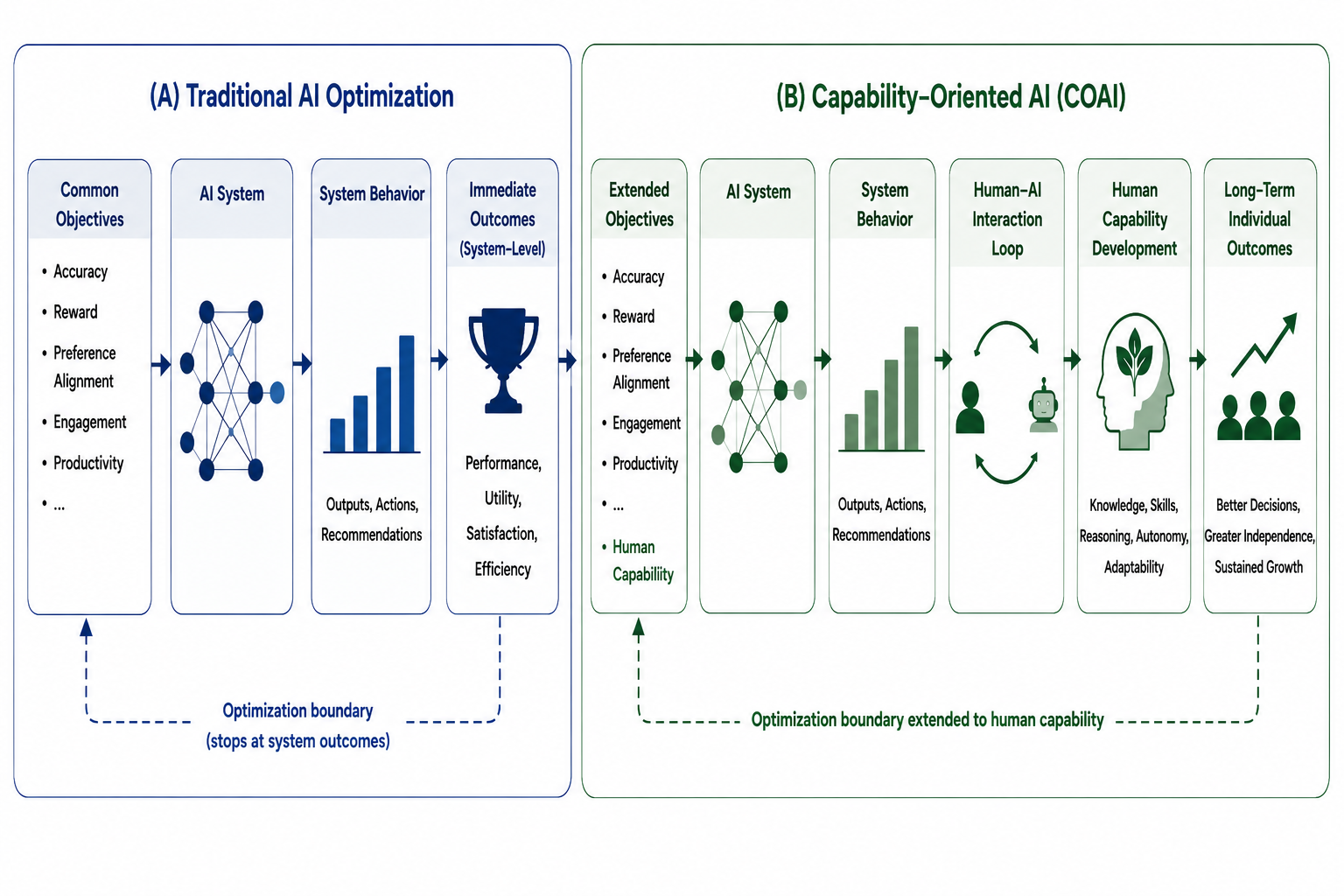
Figure 1. Capability-Oriented AI (COAI) framework. Traditional AI optimisation terminates at system-level outcomes, whereas Capability-Oriented AI extends the optimisation objective to include human capability development and long-term individual outcomes.
This perspective aligns with Capability Theory, which argues that meaningful evaluation should focus on what individuals are able to do and become rather than solely on observed outputs or achieved outcomes (Sen, 1999; Nussbaum, 2011). Applied to artificial intelligence, this implies that optimisation objectives should extend beyond maximising system performance to include expanding users' capabilities to learn, reason, solve problems, and make informed decisions independently. Consequently, capability is conceptualised not as a secondary benefit of AI adoption but as a legitimate optimisation objective in its own right.
Capability-Oriented Artificial Intelligence does not propose abandoning existing optimisation objectives. Prediction accuracy, reward maximisation, preference alignment, safety, productivity, and efficiency remain essential depending on the application domain (Russell, 2019; Shneiderman, 2022; Ouyang et al., 2022). Instead, the framework argues that these objectives should be complemented by an additional optimisation dimension that evaluates whether interaction with the intelligent system strengthens or weakens human capability over time. This transforms optimisation from a purely system-centred problem into a joint human-system optimisation problem in which successful outcomes are assessed at both the computational and human levels.
The proposal can be stated in compact notation. Conventional intelligent systems select behaviour to maximise a performance objective, denoted , evaluated over immediate outputs such as accuracy, reward, or task completion. Capability-Oriented Artificial Intelligence proposes a joint objective of the general form
where denotes the expected change in the user's capability over a defined time horizon, and the weights and express the relative importance assigned to each component in a given domain. Capability in this formulation refers to the user's ability to perform relevant tasks independently, evaluated at the end of the horizon rather than during assisted interaction. Two features of this formulation deserve emphasis. First, is evaluated over an extended horizon, which distinguishes it from engagement-style objectives that reward immediate interaction. Second, nothing algorithmic is claimed by the notation. Its purpose is to make the structural claim of the framework explicit, namely that conventional objectives contain no term through which the development of the human user enters the optimisation problem, and to indicate where future technical work on representing and estimating can attach itself.
A concrete case shows what the added term changes. Consider a junior analyst who must produce a weekly forecast, and two intelligent systems that assist them, identical in capability and differing only in objective. The first optimises performance alone: it produces the most accurate forecast it can, as quickly as it can, and by every immediate measure the analyst's output improves the day it is adopted. The second optimises the joint objective, and its behaviour on the same request is visibly different. Where the forecast turns on a judgement the analyst will one day have to make unaided, it does not simply supply the answer but surfaces the competing considerations and asks the analyst to commit before revealing its own estimate; where a step is purely mechanical, it performs it in full. To an observer watching a single week, the first system looks better, since the forecast is finished sooner and the analyst is more satisfied. The difference the second system's objective makes is invisible at one week and decisive at one year, when the analyst who used it can produce the forecast unaided and the analyst who used the first cannot. The two systems optimise the same task to the same standard; they differ only in whether the objective contains a term for the analyst, and that single term is the whole of this paper's proposal.
The framework therefore distinguishes between performance-oriented objectives and capability-oriented objectives. Performance-oriented objectives evaluate how effectively an intelligent system completes a specified task, while capability-oriented objectives evaluate whether repeated interaction improves an individual's ability to perform similar or more complex tasks independently in the future. Although these objectives will often reinforce one another, they are not necessarily equivalent. Optimising exclusively for immediate performance may encourage automation that reduces cognitive engagement, whereas incorporating capability into the optimisation objective encourages system behaviours that promote learning, reflection, adaptive reasoning, and informed decision-making.
The mechanism through which this optimisation perspective may influence human capability is summarised in Figure 2. Rather than assuming a direct relationship, the framework proposes that optimisation objectives first shape AI behaviour, which structures patterns of human-AI interaction. Through repeated interaction, these experiences contribute to capability development, which subsequently influences future decisions and performance, creating a continuous feedback process.
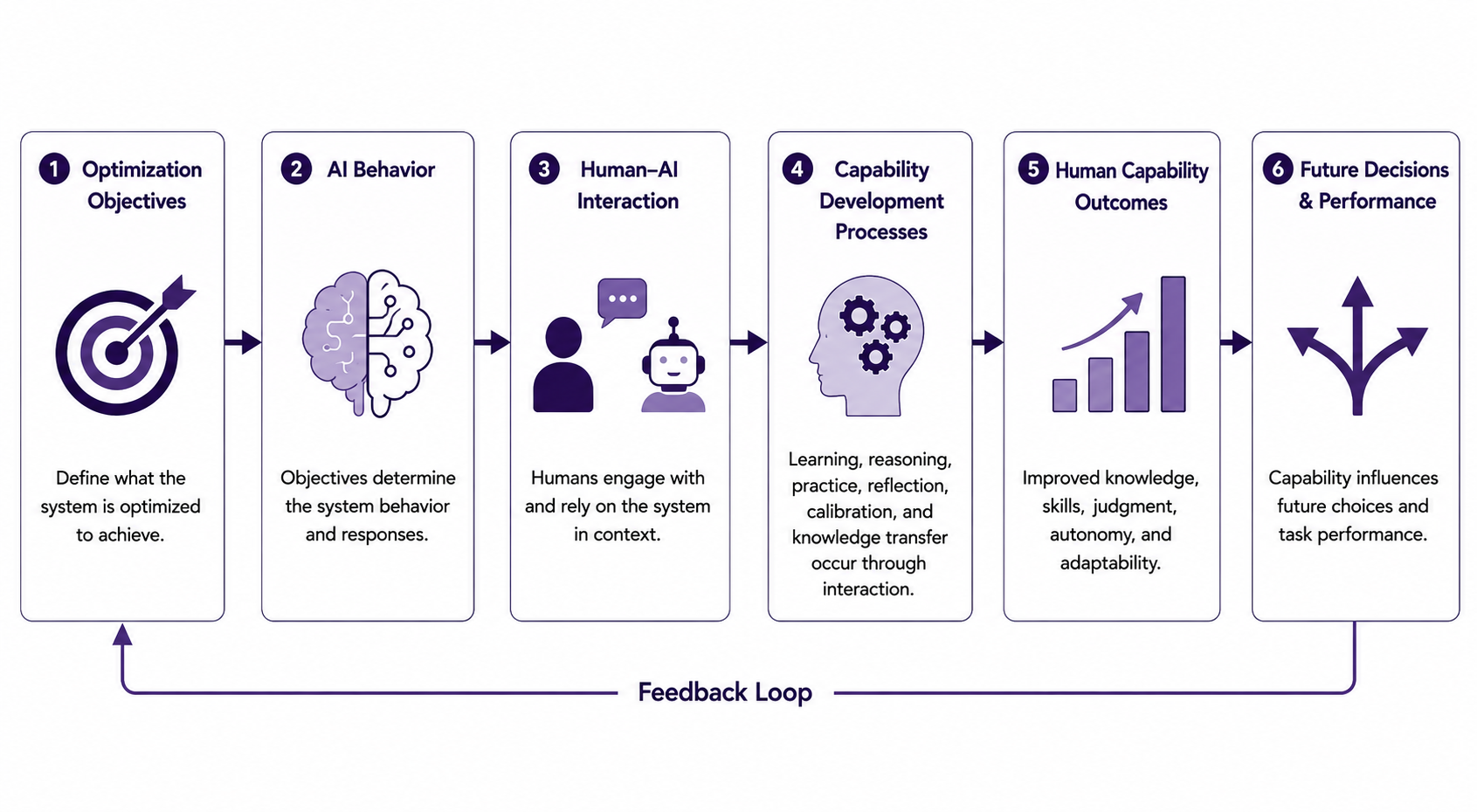
Figure 2. Mechanism linking optimisation objectives to human capability. Optimisation objectives influence AI behaviour, which structures human-AI interaction and contributes to capability development through repeated use.
If the framework is correct, its claims should be observable. They are therefore stated as three propositions, each intended to be falsifiable and each connecting the framework to an existing body of empirical method.
Proposition P2.1 (Divergence). Performance-oriented and capability-oriented objectives conflict under identifiable conditions. Specifically, where completion of a task by the system removes opportunities for practice, retrieval, or feedback, optimising immediate task performance will reduce learning and subsequent independent performance relative to calibrated assistance.
Proposition P2.2 (Assistance distribution). At equal levels of immediate task performance, systems that retain the evaluative components of a task for the human user will produce greater knowledge transfer and independent capability over time than systems that assume both the executive and the evaluative components.
Proposition P2.3 (Measurement). Any single operationalisation of capability adopted as an optimisation target will degrade as a measure of capability through proxy optimisation. Capability-oriented objectives therefore require multi-dimensional measures that are periodically revised, and the validity of any capability metric must itself be treated as an empirical question.
This distinction also provides a broader perspective on objective specification within artificial intelligence. Existing research has demonstrated that modifying optimisation objectives changes system behaviour (Bellman, 1957; Sutton & Barto, 2018; Ouyang et al., 2022; Rafailov et al., 2023). Capability-Oriented Artificial Intelligence extends this principle by proposing that changes to optimisation objectives may also influence human behavioural trajectories through sustained interaction with intelligent systems. As AI becomes increasingly embedded within education, professional practice, scientific discovery, and knowledge-intensive work, optimisation objectives shape not only computational outputs but also the feedback environments through which human capability develops (Wiener, 1948; Ashby, 1956; Ericsson et al., 1993; Bransford et al., 2000).
The proposed framework therefore reframes the optimisation problem from one centred exclusively on machine performance to one that simultaneously considers human development. Rather than asking how intelligent systems can optimise predefined computational objectives more effectively, Capability-Oriented Artificial Intelligence asks whether optimisation itself should explicitly account for the long-term capability of the people who rely upon these systems. This conceptual shift forms the principal theoretical contribution of this paper and establishes a foundation for future empirical research investigating how capability-oriented optimisation objectives may be operationalised, measured, and incorporated into the design of intelligent systems.
5. Discussion
The preceding sections argued that optimisation objectives are fundamental determinants of intelligent system behaviour and proposed that human capability should be recognised as an optimisation objective alongside existing performance-oriented objectives. This section discusses the implications of that proposition for artificial intelligence research and system design. Rather than proposing a new optimisation algorithm, the argument advanced here concerns the choice of what intelligent systems should optimise as they become increasingly integrated into human cognitive processes.
A defining characteristic of modern artificial intelligence is that optimisation objectives increasingly shape not only machine behaviour but also human behaviour. Recommendation systems influence information consumption, generative AI assists knowledge work, educational systems guide learning, and decision-support systems increasingly participate in professional judgement. In each of these settings, optimisation determines the behaviour of the AI system, but repeated interaction also influences how individuals acquire knowledge, solve problems, and make decisions. Consequently, optimisation objectives should no longer be viewed solely as mechanisms for improving computational performance; they also define the incentives and feedback that humans experience during interaction with intelligent systems.
This perspective exposes an important limitation of current optimisation paradigms. Most contemporary AI systems are evaluated using objectives that prioritise immediate performance, including predictive accuracy, cumulative reward, engagement, preference alignment, or productivity (Covington et al., 2016; Sutton & Barto, 2018; Ouyang et al., 2022). These objectives have contributed significantly to advances in artificial intelligence, yet they remain largely system-centric. Success is typically measured by improvements in model outputs or task completion rather than by examining whether prolonged interaction enhances or diminishes the capability of the human user. As AI assumes a greater role in cognitive work, this distinction becomes increasingly important because systems that maximise short-term performance may not necessarily support long-term human development.
Evidence emerging from multiple application domains suggests that this broader perspective is warranted. Studies of generative AI consistently report substantial improvements in productivity and task performance when individuals collaborate with intelligent systems (Brynjolfsson et al., 2023; Noy & Zhang, 2023; Dell'Acqua et al., 2023). Similar benefits have been observed in educational settings, where AI systems provide personalised instruction, adaptive feedback, and scalable learning support (Albadarin et al., 2024; Almasri, 2024; Mai et al., 2024). These findings demonstrate that AI can augment human performance across a wide range of cognitive tasks. However, they also highlight a limitation in current evaluation practices. Most studies assess immediate outcomes such as speed, accuracy, learning gains, or user satisfaction, while comparatively little attention is devoted to understanding how continuous interaction affects an individual's capacity for independent reasoning, knowledge transfer, and long-term expertise.
The tension identified in Proposition P2.1 is not merely hypothetical; it has an established empirical counterpart. Research on the assistance dilemma demonstrates that the level of assistance which maximises immediate task success frequently differs from the level which maximises learning (Koedinger & Aleven, 2007). Conditions that introduce difficulty and slow immediate performance can improve long-term retention and transfer (Bjork, 1994), and learners who initially struggle with problems before receiving support often develop deeper understanding than those assisted from the outset (Kapur, 2008). Translated into the language of this paper, the learning sciences have repeatedly observed that optimising and optimising prescribe different system behaviour under identifiable conditions. What the present framework adds is the recognition that contemporary intelligent systems resolve this trade-off implicitly, through objective functions that contain no capability term at all.
Viewing AI through the lens of capability shifts the focus from substitution to development. Rather than asking whether an intelligent system performs a task better than a human, the more consequential question becomes whether interaction with the system leaves the human more capable than before. This distinction reflects a transition from measuring what AI achieves to evaluating what AI enables. Such a perspective aligns naturally with Capability Theory, which evaluates progress according to the opportunities and abilities individuals possess (Sen, 1999; Nussbaum, 2011), and with research demonstrating that expertise develops through deliberate practice, effective feedback, and the transfer of knowledge across contexts (Ericsson et al., 1993; Perkins & Salomon, 1992; Bransford et al., 2000).
Two significant objections to the framework deserve direct examination. The first concerns measurement. The moment capability becomes an optimisation target, it becomes a proxy, and proxies degrade under optimisation pressure. This phenomenon, commonly summarised as Goodhart's law (Goodhart, 1975), is already familiar within artificial intelligence in the form of reward misspecification and reward hacking, where systems optimise the measurable signal rather than the outcome the signal was intended to represent (Azar et al., 2024; Chen et al., 2024). A capability-oriented system could, in principle, learn to produce the appearance of user learning rather than learning itself. Proposition P2.3 states this risk explicitly. The appropriate response is not to abandon capability objectives but to treat capability measurement with the same seriousness that reward specification now receives: multi-dimensional measures, periodic revalidation, and independent evaluation that is not itself part of the optimisation loop.
The second objection concerns incentives. Even if capability-oriented objectives are well specified, it is reasonable to ask who would adopt them. A commercial platform optimising engagement has no obvious reason to trade immediate performance for the long-term capability of its users. Brynjolfsson (2022) describes a closely related problem as the Turing Trap: economic and institutional incentives systematically favour automation that substitutes for human labour over augmentation that develops it, even where augmentation would generate greater long-term value. The present framework does not resolve this incentive problem, but it does clarify where adoption is most plausible. In education, professional training, healthcare, and organisational settings, the party paying for the system frequently has a direct interest in the capability of its users. These domains provide natural environments in which capability-oriented objectives align with existing incentives, and in which the framework can be tested before any claim is made about domains where incentives conflict.
Recognising capability as an optimisation objective also has implications for the design of future intelligent systems. Current optimisation strategies often reward systems for producing the most accurate, efficient, or preferred response. A capability-oriented perspective suggests that optimisation should additionally consider whether system behaviour encourages critical thinking, supports learning, promotes informed decision-making, and gradually reduces unnecessary dependence on automated assistance. Assistance that meets this description functions as capability scaffolding: temporary support that enables performance beyond the user's present capability while contributing to the development of independent capability, and which is therefore designed to reduce reliance over time. Scaffolding in this sense is distinguished from automation not by the amount of help it provides but by the direction in which reliance moves. The objective is not to make AI less capable or less helpful, but to ensure that optimisation considers both computational performance and its influence on human capability over sustained interaction.
This argument should not be interpreted as suggesting that capability should replace established optimisation objectives. Prediction accuracy, safety, robustness, preference alignment, and efficiency remain essential across many AI applications. Instead, the central claim is that these objectives are incomplete when intelligent systems function as long-term cognitive partners. Future optimisation problems may therefore require balancing multiple objectives in which system performance and human capability are jointly considered rather than treated as competing alternatives. Such an approach is consistent with broader developments in multi-objective optimisation, where complex systems are designed to satisfy several complementary objectives simultaneously rather than optimising a single metric in isolation (Deb, 2001).
Ultimately, the argument presented in this paper is not that existing optimisation objectives are incorrect, but that they are no longer sufficient for the emerging role of artificial intelligence. As AI evolves from specialised computational tools into persistent collaborators in education, science, healthcare, software engineering, and professional decision-making, optimisation objectives should reflect this expanded role. Human capability provides a theoretically grounded and practically relevant objective that complements existing notions of performance while recognising that the long-term value of intelligent systems depends not only on what they compute but also on how they shape the people who use them.
6. Future Research
The argument advanced in this paper is intentionally positioned at the level of optimisation objectives rather than optimisation algorithms. Consequently, the framework raises several research questions that require theoretical, empirical, and engineering investigation before capability-oriented optimisation can be incorporated into practical AI systems.
The first priority is the formalisation of human capability within optimisation frameworks. While Capability Theory provides a normative understanding of capability (Sen, 1999; Nussbaum, 2011), translating this concept into computational objectives remains an open research problem. Future work should investigate how dimensions such as reasoning ability, knowledge transfer, adaptive problem-solving, decision quality, and learning progression can be represented within optimisation frameworks without reducing capability to a single simplistic metric. Proposition P2.3 indicates why this matters: any single metric adopted as a target will degrade as a measure. This represents both a conceptual and technical challenge that will require collaboration across artificial intelligence, cognitive science, education, and human-computer interaction. The deferral of this task is deliberate rather than an omission. Defining and measuring capability are substantial research problems in their own right, and attempting to settle them in passing within a conceptual proposal would repeat the error that Proposition P2.3 warns against. The present paper therefore confines itself to establishing why capability deserves explicit specification as an optimisation objective, and leaves its operationalisation and measurement to dedicated future work.
A second direction concerns the development of evaluation methodologies. Existing AI benchmarks primarily assess system-level performance using measures such as accuracy, reward, preference alignment, or productivity. These metrics are appropriate for evaluating computational performance but are insufficient for determining whether intelligent systems strengthen or weaken human capability over time. Future research should therefore investigate longitudinal evaluation protocols capable of measuring changes in users' reasoning, independence, expertise, and ability to transfer knowledge across unfamiliar tasks. The experimental paradigms developed within the learning sciences for studying the assistance dilemma (Koedinger & Aleven, 2007) provide a natural methodological starting point, since they already compare assistance strategies against both immediate performance and subsequent independent performance. Such evaluation frameworks would complement existing AI benchmarks rather than replace them.
The proposed optimisation objective also creates opportunities for new algorithmic research. Reinforcement learning, preference optimisation, and multi-objective optimisation provide established approaches for balancing competing objectives (Sutton & Barto, 2018; Deb, 2001; Ouyang et al., 2022; Rafailov et al., 2023). Future work may explore whether capability can be incorporated as an additional optimisation objective within these existing paradigms or whether entirely new optimisation strategies are required. Understanding the trade-offs between immediate system performance and long-term capability development, stated formally in Proposition P2.1, represents an important challenge for future optimisation research.
Another important direction involves domain-specific implementation. The significance of capability-oriented optimisation is likely to vary across application areas. Educational systems naturally emphasise learning and capability development, while decision-support systems in healthcare, finance, software engineering, and public administration increasingly influence professional judgement. Investigating how capability-oriented optimisation should be adapted to different contexts will therefore be essential. It is unlikely that a single optimisation strategy will be appropriate across all application domains, suggesting that future work should identify domain-specific capability objectives and corresponding evaluation criteria. The incentive analysis presented in the Discussion further suggests that education and professional training are the domains in which adoption is most plausible, and therefore the domains in which empirical validation should begin.
Future research should also examine the long-term behavioural effects of sustained interaction with intelligent systems. Current empirical studies predominantly evaluate AI over relatively short experimental periods, often measuring immediate improvements in task performance or productivity (Brynjolfsson et al., 2023; Dell'Acqua et al., 2023; Noy & Zhang, 2023). However, optimisation objectives may produce cumulative effects that only emerge through prolonged use. Longitudinal studies are therefore needed to understand whether different optimisation strategies encourage dependence, preserve expertise, accelerate learning, or improve adaptive reasoning over months or years rather than hours or days.
Finally, the framework presented in this paper provides a foundation for extending discussions within AI Alignment and Human-Centred AI. Existing research has largely focused on ensuring that intelligent systems remain aligned with human intentions, preferences, and values (Russell, 2019; Hadfield-Menell et al., 2016; Shneiderman, 2022). Future research may investigate whether alignment itself should be expanded beyond preference satisfaction to include the preservation and enhancement of human capability. Exploring this relationship could establish a closer connection between optimisation theory, alignment research, and the long-term societal role of artificial intelligence.
Collectively, these directions highlight that recognising human capability as an optimisation objective is not the conclusion of the research agenda but its starting point. Addressing these questions will require advances in optimisation theory, evaluation methodology, algorithm design, and empirical validation. Together, they provide a pathway towards intelligent systems whose success is measured not only by the quality of their outputs but also by their contribution to sustained human capability.
7. Conclusion
Artificial intelligence has historically been defined by its ability to optimise objective functions. Whether the objective is predictive accuracy, cumulative reward, engagement, preference alignment, or productivity, the optimisation objective fundamentally determines the behaviour that an intelligent system learns to exhibit. As AI systems become increasingly embedded in human learning, reasoning, and decision-making, however, the consequences of these objectives extend beyond computational performance to influence human cognitive development itself.
This paper argued that existing optimisation objectives, while essential, are no longer sufficient to capture the broader role that intelligent systems now play. Contemporary AI increasingly functions as a cognitive partner rather than a standalone computational tool. Consequently, evaluating intelligent systems solely according to task performance overlooks an important dimension of their long-term impact: whether interaction with these systems strengthens or diminishes human capability.
Drawing on optimisation theory, reinforcement learning, decision theory, cybernetics, Capability Theory, and the learning sciences, this paper proposed that human capability should be recognised as an explicit optimisation objective for intelligent systems. Unlike existing optimisation objectives that primarily evaluate system performance, a capability-oriented objective considers whether repeated interaction enables individuals to learn more effectively, reason more independently, adapt to unfamiliar situations, and develop expertise over time. This perspective does not replace established objectives such as accuracy, safety, robustness, or preference alignment; rather, it complements them by recognising that the success of intelligent systems should also be assessed according to their contribution to sustained human development.
The proposed Capability-Oriented Artificial Intelligence framework provides a theoretical foundation for this shift by reframing optimisation as a joint human-system problem rather than a purely computational one. The framework suggests that optimisation objectives should account not only for the behaviour of intelligent systems but also for the developmental trajectories they create through continued human interaction. Its central claims are stated in falsifiable form: that performance and capability objectives diverge under identifiable conditions, that the distribution of assistance between human and system determines capability outcomes, and that capability measurement must be treated as an empirical problem in its own right. In doing so, the framework extends existing discussions in optimisation, Human-Centred AI, and AI Alignment by arguing that the choice of optimisation objective should explicitly consider its influence on human capability.
The contribution of this paper is therefore not a new optimisation algorithm or learning architecture. Instead, it advances a different proposition: that the optimisation objectives guiding intelligent systems should evolve alongside the changing role of artificial intelligence in society. As AI becomes increasingly integrated into education, scientific discovery, healthcare, software engineering, and professional decision-making, the long-term value of these systems will depend not only on how well they perform tasks but also on whether they expand the capabilities of the people who depend upon them.
Recognising human capability as an optimisation objective opens a new direction for artificial intelligence research. It invites future work on objective specification, optimisation strategies, evaluation methodologies, and longitudinal empirical validation, while providing a theoretical basis for designing intelligent systems that optimise not only for better decisions and better predictions, but ultimately for better human capability.
References
Albadarin, Y., Saqr, M., Pope, N., & Tukiainen, M. (2024). A systematic literature review of empirical research on ChatGPT in education. Discover Education, 3, Article 60. https://doi.org/10.1007/s44217-024-00138-2
Almasri, F. (2024). Exploring the impact of artificial intelligence in teaching and learning of science: A systematic review of empirical research. Research in Science Education, 54, 977–997. https://doi.org/10.1007/s11165-024-10176-3
Ashby, W. R. (1956). An introduction to cybernetics. Chapman & Hall.
Azar, M. G., Guo, Z. D., Piot, B., Munos, R., Rowland, M., Valko, M., & Calandriello, D. (2024). A general theoretical paradigm to understand learning from human preferences. Proceedings of the 27th International Conference on Artificial Intelligence and Statistics (AISTATS), PMLR 238, 4447–4455.
Bansal, G., Wu, T., Zhou, J., Fok, R., Nushi, B., Kamar, E., Ribeiro, M. T., & Weld, D. S. (2021). Does the whole exceed its parts? The effect of AI explanations on complementary team performance. Proceedings of the 2021 CHI Conference on Human Factors in Computing Systems, Article 81. https://doi.org/10.1145/3411764.3445717
Bellman, R. (1957). Dynamic programming. Princeton University Press.
Bjork, R. A. (1994). Memory and metamemory considerations in the training of human beings. In J. Metcalfe & A. Shimamura (Eds.), Metacognition: Knowing about knowing (pp. 185–205). MIT Press.
Bransford, J. D., Brown, A. L., & Cocking, R. R. (Eds.). (2000). How people learn: Brain, mind, experience, and school. National Academy Press.
Brynjolfsson, E. (2022). The Turing Trap: The promise and peril of human-like artificial intelligence. Daedalus, 151(2), 272–287. https://doi.org/10.1162/daed_a_01915
Brynjolfsson, E., Li, D., & Raymond, L. R. (2023). Generative AI at work. National Bureau of Economic Research Working Paper No. 31161.
Chen, L., Zhu, C., Soselia, D., Chen, J., Zhou, T., Goldstein, T., Huang, H., Shoeybi, M., & Catanzaro, B. (2024). ODIN: Disentangled reward mitigates hacking in RLHF. Proceedings of the 41st International Conference on Machine Learning (ICML).
Covington, P., Adams, J., & Sargin, E. (2016). Deep neural networks for YouTube recommendations. In Proceedings of the 10th ACM Conference on Recommender Systems (pp. 191–198). https://doi.org/10.1145/2959100.2959190
Deb, K. (2001). Multi-objective optimization using evolutionary algorithms. John Wiley & Sons.
Dell'Acqua, F., McFowland, E., Mollick, E. R., Lifshitz-Assaf, H., Kellogg, K. C., Rajendran, S., Krayer, L., Candelon, F., & Lakhani, K. R. (2023). Navigating the jagged technological frontier: Field experimental evidence of the effects of AI on knowledge worker productivity and quality. Harvard Business School Working Paper No. 24-013.
Engelbart, D. C. (1962). Augmenting human intellect: A conceptual framework. Stanford Research Institute.
Ericsson, K. A., Krampe, R. T., & Tesch-Römer, C. (1993). The role of deliberate practice in the acquisition of expert performance. Psychological Review, 100(3), 363–406. https://doi.org/10.1037/0033-295X.100.3.363
Goodhart, C. A. E. (1975). Problems of monetary management: The U.K. experience. In Papers in Monetary Economics (Vol. 1). Reserve Bank of Australia.
Green, B., & Chen, Y. (2019). Disparate interactions: An algorithm-in-the-loop analysis of fairness in risk assessments. In Proceedings of the Conference on Fairness, Accountability, and Transparency (pp. 90–99). https://doi.org/10.1145/3287560.3287563
Hadfield-Menell, D., Russell, S. J., Abbeel, P., & Dragan, A. D. (2016). Cooperative inverse reinforcement learning. In Advances in Neural Information Processing Systems, 29.
Hadfield-Menell, D., Milli, S., Abbeel, P., Russell, S. J., & Dragan, A. D. (2017). The off-switch game. In Proceedings of the Twenty-Sixth International Joint Conference on Artificial Intelligence (IJCAI) (pp. 220–227).
Howard, R. A. (1960). Dynamic programming and Markov processes. MIT Press.
Kahneman, D., & Tversky, A. (1979). Prospect theory: An analysis of decision under risk. Econometrica, 47(2), 263–291. https://doi.org/10.2307/1914185
Kapur, M. (2008). Productive failure. Cognition and Instruction, 26(3), 379–424. https://doi.org/10.1080/07370000802212669
Koedinger, K. R., & Aleven, V. (2007). Exploring the assistance dilemma in experiments with Cognitive Tutors. Educational Psychology Review, 19(3), 239–264. https://doi.org/10.1007/s10648-007-9049-0
Lai, V., & Tan, C. (2019). On human predictions with explanations and predictions of machine learning models: A case study on deception detection. In Proceedings of the Conference on Fairness, Accountability, and Transparency (pp. 29–38). https://doi.org/10.1145/3287560.3287590
Licklider, J. C. R. (1960). Man-computer symbiosis. IRE Transactions on Human Factors in Electronics, HFE-1, 4–11.
Mai, D. T. T., Da, C. V., & Hanh, N. V. (2024). The use of ChatGPT in teaching and learning: A systematic review through SWOT analysis approach. Frontiers in Education, 9, Article 1328769. https://doi.org/10.3389/feduc.2024.1328769
Noy, S., & Zhang, W. (2023). Experimental evidence on the productivity effects of generative artificial intelligence. Science, 381(6654), 187–192. https://doi.org/10.1126/science.adh2586
Nussbaum, M. C. (2011). Creating capabilities: The human development approach. Harvard University Press.
Ouyang, L., Wu, J., Jiang, X., Almeida, D., Wainwright, C. L., Mishkin, P., Zhang, C., Agarwal, S., Slama, K., Ray, A., Schulman, J., Hilton, J., Kelton, F., Miller, L., Simens, M., Askell, A., Welinder, P., Christiano, P., Leike, J., & Lowe, R. (2022). Training language models to follow instructions with human feedback. In Advances in Neural Information Processing Systems, 35, 27730–27744.
Perkins, D. N., & Salomon, G. (1992). Transfer of learning. In International Encyclopedia of Education (2nd ed.). Pergamon Press.
Rafailov, R., Sharma, A., Mitchell, E., Manning, C. D., Ermon, S., & Finn, C. (2023). Direct preference optimization: Your language model is secretly a reward model. In Advances in Neural Information Processing Systems, 36.
Russell, S. (2019). Human compatible: Artificial intelligence and the problem of control. Viking.
Sen, A. (1999). Development as freedom. Oxford University Press.
Shneiderman, B. (2022). Human-centered AI. Oxford University Press.
Simon, H. A. (1947). Administrative behavior. Macmillan.
Simon, H. A. (1955). A behavioral model of rational choice. The Quarterly Journal of Economics, 69(1), 99–118. https://doi.org/10.2307/1884852
Sutton, R. S., & Barto, A. G. (2018). Reinforcement learning: An introduction (2nd ed.). MIT Press.
Vaccaro, M., Almaatouq, A., & Malone, T. (2024). When combinations of humans and AI are useful: A systematic review and meta-analysis. Nature Human Behaviour, 8(12), 2293–2303. https://doi.org/10.1038/s41562-024-02024-1
von Neumann, J., & Morgenstern, O. (1944). Theory of games and economic behavior. Princeton University Press.
Vygotsky, L. S. (1978). Mind in society: The development of higher psychological processes. Harvard University Press.
Wiener, N. (1948). Cybernetics: Or control and communication in the animal and the machine. MIT Press.